Interactive Circle of Fifths
Embark on a musical journey to unlock scales, chords, and harmonies with this interactive guide.
Visit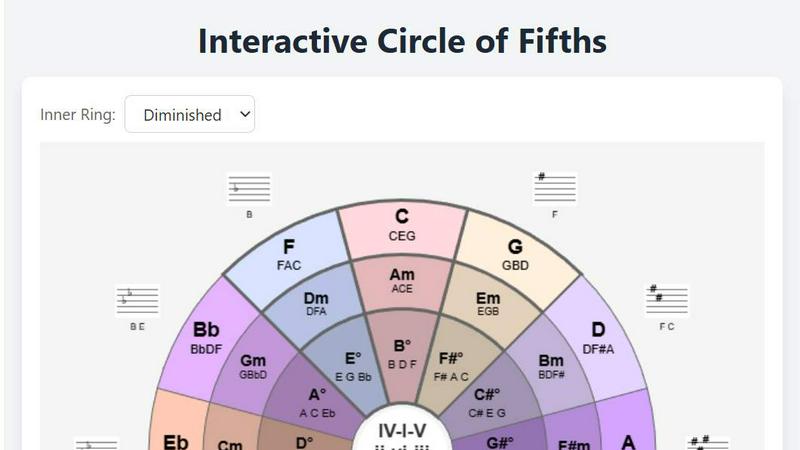
About Interactive Circle of Fifths
Imagine unlocking a map to the entire world of music, where every chord, scale, and progression is connected by a beautiful, logical pattern. This is the journey the Interactive Circle of Fifths invites you on. It's more than a static diagram; it's a living, breathing musical companion designed for anyone whose heart beats to the rhythm of creation—from the curious beginner taking their first steps into music theory to the seasoned composer seeking fresh inspiration. This tool transforms the abstract concepts of harmony into an intuitive visual and auditory experience. By simply selecting a key, you can see and hear the intricate relationships between chords, explore how they naturally resolve, and discover the scales that give them color. Its core value lies in demystifying music theory, making the profound connections that underpin all Western music accessible and engaging. Whether you're deciphering the emotional pull of a chord progression, writing a new song, or improvising a solo, the Interactive Circle of Fifths is your guide, illuminating the path through the rich landscape of keys, scales, and harmonies.
Features of Interactive Circle of Fifths
Dynamic Circle Visualization
At the heart of the tool is the interactive circle itself. Click on any key, and watch as the entire interface updates in real-time. The outer ring displays the harmonized chords for that key (like C, Dm, Em), while the inner ring allows you to layer on various scales such as Pentatonic, Blues, or Diminished. This dynamic visualization turns the theoretical circle into a practical playground, showing you exactly which notes and chords belong together in any musical context you choose to explore.
Harmonized Scale & Chord Sequencer Panel
This powerful panel displays the seven chords that naturally occur in any selected key, complete with their Roman numeral analysis (I, ii, iii, etc.). It’s your instant songwriting and analysis hub. You can click on each chord to hear it, understanding its unique color and function. Furthermore, it acts as a chord sequencer, allowing you to build and audition common progressions (like I-V-vi-IV) to hear how chords tell a story and resolve to create movement and emotion in your music.
Multi-Instrument Fretboard & Keyboard
Understanding theory is one thing; applying it to your instrument is another. This feature provides instant, synchronized diagrams for both piano keyboard and guitar fretboard. When you select a chord or scale, the tool highlights the corresponding notes and positions on these instruments. This bridges the gap between intellectual knowledge and physical play, helping you translate what you see on the circle directly to your fingers, accelerating your learning and improvisation skills.
Scale Degree & Resolution Guide
Go beyond just naming chords and understand their role in a musical story. For each chord in the harmonized scale, the tool clearly labels its scale degree and its typical "Resolves To" function. This teaches you the gravitational pull within a key—why the V chord desperately wants to go to the I, or how a ii chord sets up a V. This insight is crucial for composing compelling progressions and for improvisers who want to target notes that create satisfying melodic resolution.
Use Cases of Interactive Circle of Fifths
Songwriting & Chord Progression Discovery
Stuck in a creative rut? Songwriters can use the tool to break free from familiar patterns. By exploring the harmonized scale panel, you can experiment with non-diatonic chords from related keys or use the chord sequencer to build and hear new progressions instantly. It helps you find that perfect chord that adds surprise or emotional depth, turning a simple melody into a complete, harmonically rich composition.
Music Theory Learning & Tutoring
For students and teachers, this tool is an invaluable educational asset. It makes abstract concepts tangible. A teacher can demonstrate how changing the key shifts all relationships, or how a Blues scale overlays on a standard progression. Students can interactively test their knowledge, seeing and hearing the results of their choices, which reinforces learning far more effectively than a textbook diagram ever could.
Instrument Practice & Improvisation
Practicing musicians can use it as a focused practice companion. A guitarist can select a key and the "Blues Scale" overlay to see the exact fretboard patterns for a 12-bar blues in that key. A pianist can explore the "Diminished Chord" functions to practice passing chords. It provides a structured yet creative framework for scale runs, arpeggio practice, and developing melodic ideas that are firmly rooted in the song's harmony.
Music Analysis & Appreciation
Deepen your listening experience by analyzing your favorite songs. When you hear a captivating chord change, you can use the tool to find the key and identify the borrowed chord or modulation the artist used. Understanding that a song uses a iv chord from the parallel minor, for example, adds a new layer of appreciation for the craft behind the music you love.
Frequently Asked Questions
Is the Interactive Circle of Fifths suitable for complete beginners?
Absolutely. The tool is designed to guide beginners on their musical journey. It starts with simple, clear visualizations of major keys and basic chords. By clicking and hearing the relationships, you learn intuitively. The integrated piano and guitar diagrams help you connect the theory directly to your instrument, making it an ideal starting point for grasping foundational concepts without overwhelming jargon.
Can I use this tool for genres outside of classical or jazz, like pop or rock?
Yes, definitively. The principles of the Circle of Fifths and diatonic harmony are the foundation of most Western music, including pop, rock, blues, and country. The included scales like Pentatonic and Blues are essential for these genres. The tool helps you understand the chord progressions that power countless hit songs and provides the scale knowledge needed for crafting iconic guitar solos and riffs.
How does the "Resolves To" feature help me as a musician?
The "Resolves To" feature teaches you about musical tension and release—the engine of emotion in music. Knowing that the V chord (dominant) naturally resolves to the I (tonic) helps you create satisfying endings. Understanding secondary resolutions (like vi going to ii or V) allows you to build more nuanced and interesting progressions, giving your compositions a professional sense of direction and flow.
Do I need to be able to read sheet music to use this tool?
No, reading standard sheet music is not required. The tool communicates visually with the circle and instrument diagrams, and auditorily with direct sound feedback. You learn by seeing relationships on the circle, hearing the chords and scales, and mapping them to your instrument's layout. It’s a practical, application-focused approach to music theory.
Explore more in this category:
Similar to Interactive Circle of Fifths

Wordy
Learn languages with real movie and TV show clips.

PDFKing
Free online PDF tools to merge, compress, convert, edit, sign, and manage documents—no signup, watermarks, or daily limits.

Construction Calculator
Free construction calculators with formulas, steps, and assumptions.

Melodank
Melodank turns your memories and special occasions into unique German or English songs you can preview and share as digital gifts.


YT Video Summarizer
Turn Long YouTube Videos into Quick AI Summaries in Seconds.