act101
act101 gives your AI agent 163 grammars to refactor and port code across languages, keeping everything on your machine.
Visit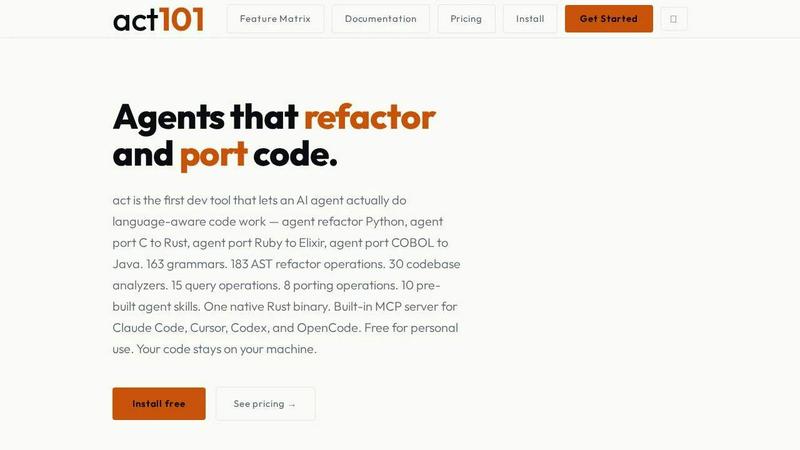
About act101
Imagine you are an engineer deep in the trenches of a legacy codebase, staring at a sprawling Python monolith that needs to be refactored into clean, maintainable modules. Or perhaps you are tasked with the monumental effort of porting a critical C library to Rust. In the past, this meant weeks of manual labor, endless context switching, and the constant fear of breaking something. Now, there is a new kind of tool that changes everything. act101 is the first developer tool that allows an AI agent to actually perform language-aware code work, not just chat about it. It is a native Rust binary that acts as a Model Context Protocol (MCP) server, giving AI coding agents like Claude Code, Cursor, and Codex the ability to perform 183 AST refactor operations, 30 codebase analyzers, 15 query operations, and 8 porting operations across an astounding 163 programming languages. The core promise is simple: your AI agent can now refactor Python, port C to Rust, or migrate Ruby to Elixir with precision, all while your code stays on your machine. No indexing, no caching, no cold starts. It is a tool built for engineers who want to move fast without breaking things, turning the dream of a truly autonomous coding assistant into a tangible reality.
Features of act101
183 AST-Aware Refactor Operations
act101 gives your AI agent a surgical toolkit of 183 Abstract Syntax Tree (AST) aware refactoring operations. Unlike traditional whole-file rewrites that destroy formatting and lose comments, these operations are precise and context-aware. Your agent can call functions like extract-function to pull a block of code into its own method, rename to safely update a symbol across an entire workspace, or move-symbol to relocate a module and automatically update every single import. It can also convert a Python class to a dataclass, extract a trait from a Rust struct, or inline a variable. Each operation is executed with automatic checkpointing, meaning the agent can instantly undo any change if something looks wrong. This level of control transforms the agent from a chaotic text generator into a disciplined, language-aware engineer that respects the integrity of your codebase.
8 Cross-Language Porting Operations
Porting code between languages is one of the most complex and error-prone tasks in software engineering. act101 tackles this head-on with a state machine approach that guides the AI agent through the entire migration process. The agent starts with a port_contract operation to anchor the source-to-target migration, defining the scope and rules. It then uses port_inventory to enumerate every single symbol that must be moved. A port_order operation resolves the dependency ordering, ensuring that foundational elements are ported first. Finally, a port_manifest state machine tracks progress through init, add, update, remove, and note steps. This structured process works between any two of the 163 supported grammars, whether you are porting C to Rust, Ruby to Elixir, or even COBOL to Java. It turns a chaotic migration into a manageable, step-by-step engineering workflow.
30 Codebase Analyzers
Before an AI agent can safely refactor or port code, it needs to understand the structural landscape of the codebase. act101 provides 30 built-in codebase analyzers that give the agent a deep, structural map of your repository. These analyzers can measure cohesion and coupling between modules, detect cycles in dependency graphs, identify chokepoints and hotspots where complexity is highest, and find dead code that can be safely removed. They can also analyze layers, seams, clusters, and fan balance to understand the architecture. For migration projects, there is a dedicated migration readiness analyzer that assesses how prepared a codebase is for a language shift. With this data, the agent can make informed decisions, avoid hidden pitfalls, and provide you with a clear, data-driven report on the health and structure of your code before it even touches a single line.
10 Pre-Built Agent Skills
act101 comes with 10 pre-built agent skills that compose its raw operations into common, high-level engineering workflows. These skills turn the tool into an intelligent assistant that can handle complex tasks with a single command. For example, the architecture-audit skill will run a suite of analyzers to produce a comprehensive structural overview of your codebase. The code-review skill will examine your code for potential issues and suggest improvements using the refactor operations. The migration-assessment skill will evaluate the feasibility and effort required to port code between languages. Other skills include boundary-analysis, change-impact, health-check, and architectural-refactoring. You can invoke these skills directly in Claude Code, Cursor, or other MCP-aware clients using a simple /skill-name command, making it incredibly easy to leverage the full power of act101 without having to manually orchestrate each operation.
Use Cases of act101
Large-Scale Python Monolith Refactoring
A team inherits a decade-old Python monolith that has grown into a tangled mess of functions and classes. Using act101, they connect their AI coding agent to the codebase. The agent first runs the architecture-audit skill to map out the coupling and cycles. It then systematically uses operations like extract-function, extract-class, and move-symbol to decompose the monolith into a clean, modular structure. The agent can rename symbols across the entire project, convert classes to dataclasses, and organize imports with a single call. Because every operation is checkpointed, the team can review each change and instantly revert if needed. What would have taken weeks of manual, error-prone work is accomplished in hours, with the agent handling the grunt work while the team focuses on architectural decisions.
Porting a Critical C Library to Rust
A company needs to port a high-performance C networking library to Rust for improved safety and concurrency. They use act101 to guide their agent through the process. The agent starts by running port_contract to define the scope of the migration. It then uses port_inventory to list every function, struct, and macro that needs to be ported. The port_order operation ensures that the dependency graph is respected, porting foundational data structures before the functions that use them. The agent then uses the port_manifest state machine to track its progress, adding translated Rust code, updating function signatures, and removing the original C equivalents as they are verified. The 30 codebase analyzers help identify potential issues, such as unsafe patterns in the C code that need special handling in Rust. The result is a methodical, verifiable migration that significantly reduces the risk of introducing bugs.
Automated Code Review and Refactoring in a CI Pipeline
A development team integrates act101 into their CI/CD pipeline to automatically review and refactor every pull request. When a new PR is submitted, the agent runs the code-review skill, which uses the 30 analyzers to scan for issues like high coupling, dead code, or architectural violations. If problems are found, the agent can propose fixes using the refactor operations, such as suggesting an extract-function to reduce a method's complexity or a rename to improve clarity. The agent can even apply these refactors directly, creating a new commit that the developer can review and merge. This automation ensures that code quality standards are consistently enforced, freeing senior developers from tedious review tasks and allowing them to focus on the most critical architectural feedback.
Cross-Language Codebase Migration Assessment
A company is considering migrating a legacy Ruby on Rails application to Elixir for better concurrency and fault tolerance. Before committing to a full migration, they use act101 to run a migration-assessment. The agent uses the migration readiness analyzer to evaluate the Ruby codebase, identifying which modules are most tightly coupled to Ruby-specific features and which are more portable. It uses port_inventory to count the symbols that would need to be moved and provides an estimate of the effort required. The agent can even produce a sample port of a small, isolated module from Ruby to Elixir using the porting operations, giving the team a concrete proof of concept. This data-driven assessment allows the company to make an informed decision about the feasibility, cost, and timeline of the migration, avoiding a potentially disastrous leap into the unknown.
Frequently Asked Questions
How does act101 ensure my code remains private and secure?
act101 is built with privacy and security as core principles. It is a native Rust binary that runs entirely on your machine. There is no indexing, no caching, and no cold start because it parses code on every call, meaning results are never stale and no persistent data is stored. Your code never leaves your machine, as act101 does not send your source code to any external server for processing. The only potential external communication is for license verification, which may contact our servers to validate your license key. There is no telemetry, no plugin runtime, and no package graph, which eliminates any supply-chain attack surface. This design ensures that even the most sensitive codebases remain completely under your control.
What is the difference between a whole-file rewrite and act101's AST-aware operations?
A whole-file rewrite, which is what most AI coding agents do by default, treats your code as plain text. The agent generates a new version of the file, which often results in lost comments, broken formatting, and subtle semantic changes that are hard to detect. In contrast, act101 operates on the Abstract Syntax Tree (AST) of your code. This means it understands the grammatical structure of the language, allowing it to perform precise, surgical operations like extracting a function or renaming a symbol. These operations preserve comments, maintain formatting, and ensure cross-file consistency. Furthermore, every operation is checkpointed, allowing for instant undo. This precision and safety are what make act101 a true engineering tool rather than a text generator.
Which AI coding agents and IDEs are compatible with act101?
act101 is designed to be a Model Context Protocol (MCP) server, which is a standardized protocol for integrating tools with AI agents. This means it works seamlessly with any MCP-aware client. The primary supported agents include Claude Code, Cursor, Codex, and OpenCode. It also works with Windsurf and any other MCP-compatible coding assistant. The setup is straightforward: you run the act101 binary, which starts the MCP server, and then configure your AI agent to connect to it. Once connected, the agent gains access to all 183 refactor operations, 30 analyzers, and 8 porting operations. This broad compatibility means you can use act101 with your preferred AI tool, whether you are in a terminal, an IDE, or a dedicated AI coding environment.
How does act101 handle the complexity of porting code between two very different languages?
Porting code between languages like C and Rust or Ruby and Elixir is inherently complex due to differences in paradigms, memory models, and standard libraries. act101 does not claim to automate the entire process blindly. Instead, it provides a structured state machine that guides the AI agent through the migration step by step. The agent first establishes a contract defining the scope. It then inventories every symbol to be ported, resolves the dependency order, and uses a manifest to track progress. The agent uses the 30 codebase analyzers to understand the source code's structure and identify potential pitfalls. The actual translation is handled by the AI model, but act101 ensures that the process is methodical, verifiable, and reversible. This dramatically reduces the risk of errors and makes the migration manageable, even for large codebases.
Pricing of act101
act101 is free for personal use. This gives individual developers full access to all features, including the 183 refactor operations, 30 codebase analyzers, 8 porting operations, and 10 pre-built agent skills. For professional and team use, there is a paid pricing tier that offers additional features such as priority support, advanced license management, and the ability to use act101 in commercial environments. For detailed pricing information on the professional and enterprise tiers, please visit the official act101 pricing page.
Similar to act101

Sprite Sheet Maker
A free browser-based toolkit for creating, cutting, converting, and previewing sprite sheet animations.


laya.tools
A free directory of 950+ projects built on Laya, the open-source decision model. Updated daily.
JsonTranslate
Translate JSON, Markdown, and TXT while preserving keys, nested paths, and project structure.

Forms Plugin
The #1 Native Form Builder Plugin for Framer - No Code, No Embeds, No External Platforms.