
Interactive Circle of Fifths vs Psychiatry Exams
Side-by-side comparison to help you choose the right product.

Interactive Circle of Fifths
Embark on a musical journey to unlock scales, chords, and harmonies with this interactive guide.
Last updated: March 1, 2026

Psychiatry Exams
Master your MRCPsych journey with AI-powered practice questions and expert community support.
Last updated: March 1, 2026
Visual Comparison
Interactive Circle of Fifths
Psychiatry Exams
Feature Comparison
Interactive Circle of Fifths
Dynamic Circle Visualization
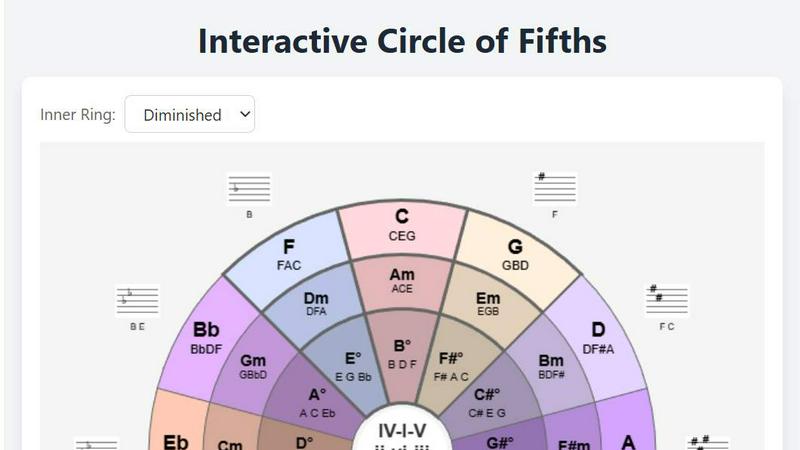
At the heart of the tool is the interactive circle itself. Click on any key, and watch as the entire interface updates in real-time. The outer ring displays the harmonized chords for that key (like C, Dm, Em), while the inner ring allows you to layer on various scales such as Pentatonic, Blues, or Diminished. This dynamic visualization turns the theoretical circle into a practical playground, showing you exactly which notes and chords belong together in any musical context you choose to explore.
Harmonized Scale & Chord Sequencer Panel
This powerful panel displays the seven chords that naturally occur in any selected key, complete with their Roman numeral analysis (I, ii, iii, etc.). It’s your instant songwriting and analysis hub. You can click on each chord to hear it, understanding its unique color and function. Furthermore, it acts as a chord sequencer, allowing you to build and audition common progressions (like I-V-vi-IV) to hear how chords tell a story and resolve to create movement and emotion in your music.
Multi-Instrument Fretboard & Keyboard
Understanding theory is one thing; applying it to your instrument is another. This feature provides instant, synchronized diagrams for both piano keyboard and guitar fretboard. When you select a chord or scale, the tool highlights the corresponding notes and positions on these instruments. This bridges the gap between intellectual knowledge and physical play, helping you translate what you see on the circle directly to your fingers, accelerating your learning and improvisation skills.
Scale Degree & Resolution Guide
Go beyond just naming chords and understand their role in a musical story. For each chord in the harmonized scale, the tool clearly labels its scale degree and its typical "Resolves To" function. This teaches you the gravitational pull within a key—why the V chord desperately wants to go to the I, or how a ii chord sets up a V. This insight is crucial for composing compelling progressions and for improvisers who want to target notes that create satisfying melodic resolution.
Psychiatry Exams
Verified Recalled Question Bank
Walk into your exam with the confidence of having seen the terrain before. Our extensive bank features over 2,400 questions, including nearly 2,000 directly recalled from real exam sittings. These aren't just raw memories; each question is carefully adapted, verified, and refined by our panel of eight NHS Consultants, ensuring they are accurate, relevant, and pedagogically sound for your current preparation journey.
AI-Powered, Syllabus-Grounded Explanations
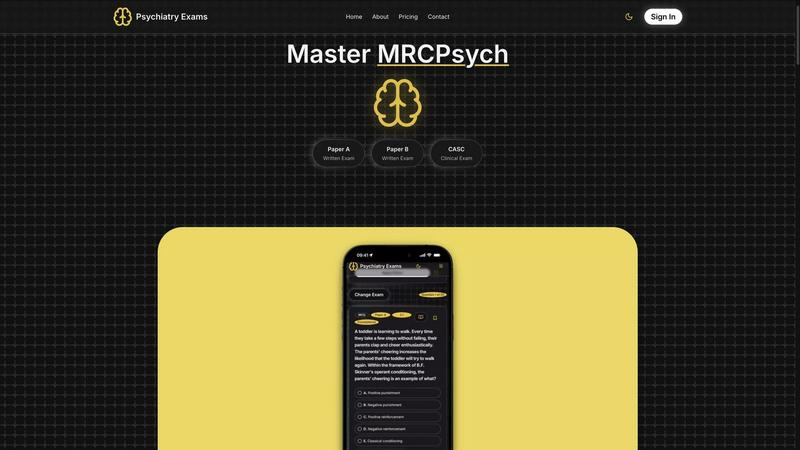
Every question unlocks a deeper layer of understanding. Our answers are generated by cutting-edge AI models like Claude Opus and GPT-5, but they are never left to their own devices. Each explanation is meticulously grounded in the official Royal College syllabus and adult learning theory, and overseen by consultant expertise. This fusion provides detailed, narrative-driven insights that help you build connections, not just memorize facts.
Active Learning & Community Ecosystem
Your learning journey becomes part of a collective ascent. We incentivize active engagement by awarding AI credits for contributing and peer-reviewing questions. This process, praised by our users, cements knowledge more effectively than passive reading. Furthermore, you join a thriving WhatsApp community with dedicated discussion areas for each exam sitting, moderated by consultants, creating a supportive network that keeps you motivated and on track.
Comprehensive Syllabus Mapping & Flashcards
Navigate the vast MRCPsych syllabus with a trusted guide. Our entire content library—from questions to study notes—is meticulously mapped to the official College learning objectives for Paper A, Paper B, and CASC. Complementing this is an integrated flashcard system employing spaced repetition algorithms, helping you master key concepts and ensure optimal long-term retention of critical information.
Use Cases
Interactive Circle of Fifths
Songwriting & Chord Progression Discovery
Stuck in a creative rut? Songwriters can use the tool to break free from familiar patterns. By exploring the harmonized scale panel, you can experiment with non-diatonic chords from related keys or use the chord sequencer to build and hear new progressions instantly. It helps you find that perfect chord that adds surprise or emotional depth, turning a simple melody into a complete, harmonically rich composition.
Music Theory Learning & Tutoring
For students and teachers, this tool is an invaluable educational asset. It makes abstract concepts tangible. A teacher can demonstrate how changing the key shifts all relationships, or how a Blues scale overlays on a standard progression. Students can interactively test their knowledge, seeing and hearing the results of their choices, which reinforces learning far more effectively than a textbook diagram ever could.
Instrument Practice & Improvisation
Practicing musicians can use it as a focused practice companion. A guitarist can select a key and the "Blues Scale" overlay to see the exact fretboard patterns for a 12-bar blues in that key. A pianist can explore the "Diminished Chord" functions to practice passing chords. It provides a structured yet creative framework for scale runs, arpeggio practice, and developing melodic ideas that are firmly rooted in the song's harmony.
Music Analysis & Appreciation
Deepen your listening experience by analyzing your favorite songs. When you hear a captivating chord change, you can use the tool to find the key and identify the borrowed chord or modulation the artist used. Understanding that a song uses a iv chord from the parallel minor, for example, adds a new layer of appreciation for the craft behind the music you love.
Psychiatry Exams
The Overwhelmed CT1/CT2 Starting Their Journey
For the new trainee facing the mountain of the MRCPsych for the first time, Psychiatry Exams provides the essential map and basecamp. Instead of wasting time figuring out what to study, they can immediately engage with syllabus-mapped content and real recalled questions, building foundational knowledge efficiently within a supportive community, transforming anxiety into a structured, confident plan.
The Busy Registrar Cramming for a Re-sit
Juggling clinical duties and revision for a second attempt is a unique challenge. Our platform offers high-yield, mobile-friendly practice with precise, AI-powered explanations that maximize understanding from every minute spent. The focused question bank and flashcard system allow for targeted, efficient revision on the go, turning downtime into productive study sessions.
The Collaborative Learner Seeking Depth
Some professionals learn best through discussion and teaching. For them, our active learning model is perfect. By contributing recalled questions, participating in peer review, and engaging in community forums, they engage with the material at a consultant level, solidifying their knowledge through explanation and debate, which is often the key to ultimate mastery.
The Candidate Preparing for the CASC Exam
The Clinical Assessment of Skills and Competencies (CASC) requires a different skillset. Our platform provides dedicated CASC vignettes and a community that includes practice group calls. This allows candidates to move beyond written knowledge, practicing the communication and clinical reasoning skills essential for success in the intimidating exam station environment.
Overview
About Interactive Circle of Fifths
Imagine unlocking a map to the entire world of music, where every chord, scale, and progression is connected by a beautiful, logical pattern. This is the journey the Interactive Circle of Fifths invites you on. It's more than a static diagram; it's a living, breathing musical companion designed for anyone whose heart beats to the rhythm of creation—from the curious beginner taking their first steps into music theory to the seasoned composer seeking fresh inspiration. This tool transforms the abstract concepts of harmony into an intuitive visual and auditory experience. By simply selecting a key, you can see and hear the intricate relationships between chords, explore how they naturally resolve, and discover the scales that give them color. Its core value lies in demystifying music theory, making the profound connections that underpin all Western music accessible and engaging. Whether you're deciphering the emotional pull of a chord progression, writing a new song, or improvising a solo, the Interactive Circle of Fifths is your guide, illuminating the path through the rich landscape of keys, scales, and harmonies.
About Psychiatry Exams
The journey to becoming a Member of the Royal College of Psychiatrists (MRCPsych) is a formidable path, marked by intense study, financial strain, and the pressure of high-stakes exams. Psychiatry Exams was born from a simple, powerful idea: what if this arduous journey could be transformed? We envisioned a companion for every psychiatry trainee—a single, accessible platform that consolidates the chaos of preparation into a clear, collaborative, and cost-effective roadmap. This is more than just a question bank; it's a revolution in how medical professionals prepare. We built a mobile-friendly sanctuary specifically for MRCPsych candidates, understanding that your study time is precious and often stolen between shifts. Our platform dismantles the traditional barriers by offering an all-in-one membership that replaces scattered textbooks and expensive courses. At its core is a sophisticated AI, trained on the latest College syllabus, which works alongside NHS Consultants to generate insightful, tailored explanations. But the true magic lies in our community. By fostering active contribution through recalled questions and peer discussion, we turn solitary revision into a shared mission. This is your story of mastery, and we are here to equip you for every chapter—from Paper A and B to the CASC clinical exam—with the tools, support, and intelligence to not just pass, but to truly understand.
Frequently Asked Questions
Interactive Circle of Fifths FAQ
Is the Interactive Circle of Fifths suitable for complete beginners?
Absolutely. The tool is designed to guide beginners on their musical journey. It starts with simple, clear visualizations of major keys and basic chords. By clicking and hearing the relationships, you learn intuitively. The integrated piano and guitar diagrams help you connect the theory directly to your instrument, making it an ideal starting point for grasping foundational concepts without overwhelming jargon.
Can I use this tool for genres outside of classical or jazz, like pop or rock?
Yes, definitively. The principles of the Circle of Fifths and diatonic harmony are the foundation of most Western music, including pop, rock, blues, and country. The included scales like Pentatonic and Blues are essential for these genres. The tool helps you understand the chord progressions that power countless hit songs and provides the scale knowledge needed for crafting iconic guitar solos and riffs.
How does the "Resolves To" feature help me as a musician?
The "Resolves To" feature teaches you about musical tension and release—the engine of emotion in music. Knowing that the V chord (dominant) naturally resolves to the I (tonic) helps you create satisfying endings. Understanding secondary resolutions (like vi going to ii or V) allows you to build more nuanced and interesting progressions, giving your compositions a professional sense of direction and flow.
Do I need to be able to read sheet music to use this tool?
No, reading standard sheet music is not required. The tool communicates visually with the circle and instrument diagrams, and auditorily with direct sound feedback. You learn by seeing relationships on the circle, hearing the chords and scales, and mapping them to your instrument's layout. It’s a practical, application-focused approach to music theory.
Psychiatry Exams FAQ
How accurate and reliable are the recalled questions?
Our recalled questions are the cornerstone of the platform, but we never rely on recall alone. Every submitted question undergoes a rigorous two-stage process: first, it is adapted by our team, then it is verified and refined by our panel of eight practicing NHS Consultants. This ensures clinical accuracy, alignment with the current exam format, and educational value, giving you reliable and high-quality practice material.
What makes your AI explanations better than other question banks?
Our AI does not operate in a vacuum. We use advanced models like GPT-5 specifically trained on the latest MRCPsych syllabus. Most importantly, every AI-generated explanation is grounded in official College learning objectives and reviewed within our consultant-moderated framework. This creates explanations that are not just factually correct, but contextually rich and designed to enhance deep understanding, mirroring the reasoning you need for the exam.
How does the "Earn AI Credits" system work?
We believe you learn best by doing. When you contribute a recalled question, you earn +2 AI credits. If that submission is approved by our moderation team, you receive a +3 bonus. These credits can be used to access advanced platform features or additional content. This system rewards your contribution to the community and actively engages you in the learning process, which profoundly reinforces your own knowledge.
Is there support for the CASC clinical exam?
Absolutely. We provide dedicated preparation for the CASC with a growing library of clinical vignettes designed to mimic the exam stations. More importantly, our vibrant WhatsApp community includes consultant-moderated discussion channels specifically for CASC, and often facilitates peer-led practice group calls, offering a space to hone your clinical communication and examination skills in a supportive environment.
Alternatives
Interactive Circle of Fifths Alternatives
Every musician's journey is unique, and the path to mastering theory is paved with different tools. The Interactive Circle of Fifths is a comprehensive digital guide in the education and learning space, designed to illuminate the relationships between keys, chords, and scales through an immersive blend of sight and sound. It’s a companion for those eager to explore music's foundational language. Yet, every traveler may seek a different map. Some may be looking for a simpler starting point, a different pricing model, or a tool tailored to a specific instrument or platform. The quest for an alternative often stems from a desire to find the perfect fit for one’s individual learning style, budget, or creative workflow. When searching for a different guide on your musical journey, consider what truly fuels your progress. Look for a tool that resonates with your primary instrument, offers the depth of theory you wish to explore, and provides a learning experience—be it visual, auditory, or hands-on—that keeps you engaged and moving forward.
Psychiatry Exams Alternatives
Psychiatry Exams is a specialized online learning platform in the Education & Learning category, built to guide psychiatry trainees through the demanding MRCPsych exam journey. It consolidates recalled questions, AI insights, and community support into a single, mobile-first resource to streamline preparation. Candidates often explore alternatives for various reasons. Some seek different pricing models or free tiers, while others prioritize specific features like question bank size, study modalities, or the depth of expert review. The need for a particular user experience, such as desktop-focused platforms or different community structures, also drives the search. When evaluating other options, look for a solution that truly aligns with your learning journey. Consider the quality and sourcing of the question bank, the robustness of explanations, and whether the platform’s tools—like spaced repetition systems—complement your study habits. A supportive, engaged community can be just as valuable as the core content.