
Code Word Solver - Missing Words Finder vs Interactive Circle of Fifths
Side-by-side comparison to help you choose the right product.

Code Word Solver - Missing Words Finder
Unlock the secrets of codewords effortlessly with our intuitive solver, guiding you to the answers you seek.
Last updated: February 27, 2026

Interactive Circle of Fifths
Embark on a musical journey to unlock scales, chords, and harmonies with this interactive guide.
Last updated: March 1, 2026
Visual Comparison
Code Word Solver - Missing Words Finder
Interactive Circle of Fifths
Feature Comparison
Code Word Solver - Missing Words Finder
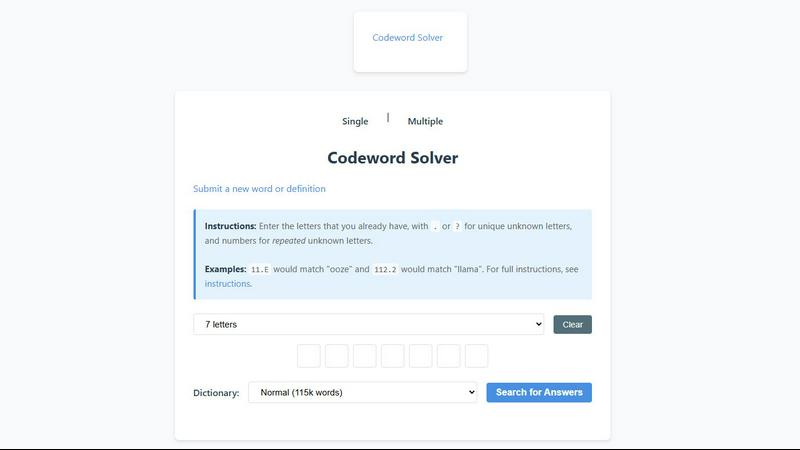
Single Pattern Solving
This feature allows you to enter a single word pattern and receive a list of matching word candidates. By inputting what you already know, the solver narrows down the possibilities, giving you a clear path forward. This is particularly useful when you're stuck and need a hint to progress without compromising your puzzle-solving integrity.
Multi-Pattern Solving
With the multi-pattern solving feature, you can enter two patterns simultaneously, enabling you to solve linked words side-by-side. This is beneficial when the same letter-number relationships appear across different words, facilitating a more comprehensive approach to solving complex puzzles. It allows for greater efficiency and ensures that you are considering all possible connections.
Flexible Input Options
The Code Word Solver offers versatile input options that cater to your specific needs. You can use periods or question marks to represent unique unknown letters and numbers for repeated unknown letters, ensuring the solver maintains consistency. For example, entering "112.2" would help you find words like "llama," making the process intuitive and user-friendly.
Customizable Difficulty Dictionaries
Recognizing that not all players are the same, the tool provides different dictionary sizes tailored to various skill levels. You can choose from hard (260k words), normal (115k words), or easy (20k words) dictionaries, ensuring that your puzzle-solving experience is perfectly matched to your capabilities and preferences.
Interactive Circle of Fifths
Dynamic Circle Visualization
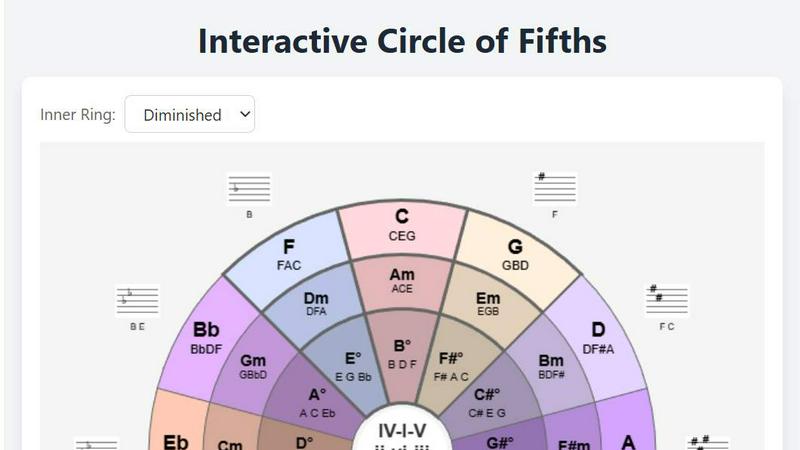
At the heart of the tool is the interactive circle itself. Click on any key, and watch as the entire interface updates in real-time. The outer ring displays the harmonized chords for that key (like C, Dm, Em), while the inner ring allows you to layer on various scales such as Pentatonic, Blues, or Diminished. This dynamic visualization turns the theoretical circle into a practical playground, showing you exactly which notes and chords belong together in any musical context you choose to explore.
Harmonized Scale & Chord Sequencer Panel
This powerful panel displays the seven chords that naturally occur in any selected key, complete with their Roman numeral analysis (I, ii, iii, etc.). It’s your instant songwriting and analysis hub. You can click on each chord to hear it, understanding its unique color and function. Furthermore, it acts as a chord sequencer, allowing you to build and audition common progressions (like I-V-vi-IV) to hear how chords tell a story and resolve to create movement and emotion in your music.
Multi-Instrument Fretboard & Keyboard
Understanding theory is one thing; applying it to your instrument is another. This feature provides instant, synchronized diagrams for both piano keyboard and guitar fretboard. When you select a chord or scale, the tool highlights the corresponding notes and positions on these instruments. This bridges the gap between intellectual knowledge and physical play, helping you translate what you see on the circle directly to your fingers, accelerating your learning and improvisation skills.
Scale Degree & Resolution Guide
Go beyond just naming chords and understand their role in a musical story. For each chord in the harmonized scale, the tool clearly labels its scale degree and its typical "Resolves To" function. This teaches you the gravitational pull within a key—why the V chord desperately wants to go to the I, or how a ii chord sets up a V. This insight is crucial for composing compelling progressions and for improvisers who want to target notes that create satisfying melodic resolution.
Use Cases
Code Word Solver - Missing Words Finder
Quick Problem-Solving for Casual Players
Casual players can use the Code Word Solver to quickly find answers when they encounter tricky puzzles. By inputting known letters and patterns, players can receive immediate suggestions, allowing them to continue enjoying their favorite puzzles without interruption.
Enhancing Competitive Play
For those who engage in competitive puzzle-solving, this tool becomes an invaluable asset. It enables players to solve puzzles faster than their opponents by providing accurate word candidates based on their known patterns, giving them a competitive edge in puzzle competitions.
Educational Tool for Students
Teachers and students can utilize the Code Word Solver as an educational resource. By encouraging students to learn letter-number associations and word patterns, it fosters critical thinking and improves vocabulary skills while making learning fun and interactive.
Community Engagement through Word Submission
Puzzle enthusiasts can contribute to the tool's growth by submitting new words and definitions. This feature encourages community engagement and ensures that the database remains up-to-date with a diverse range of words, continuously enhancing the user experience for all.
Interactive Circle of Fifths
Songwriting & Chord Progression Discovery
Stuck in a creative rut? Songwriters can use the tool to break free from familiar patterns. By exploring the harmonized scale panel, you can experiment with non-diatonic chords from related keys or use the chord sequencer to build and hear new progressions instantly. It helps you find that perfect chord that adds surprise or emotional depth, turning a simple melody into a complete, harmonically rich composition.
Music Theory Learning & Tutoring
For students and teachers, this tool is an invaluable educational asset. It makes abstract concepts tangible. A teacher can demonstrate how changing the key shifts all relationships, or how a Blues scale overlays on a standard progression. Students can interactively test their knowledge, seeing and hearing the results of their choices, which reinforces learning far more effectively than a textbook diagram ever could.
Instrument Practice & Improvisation
Practicing musicians can use it as a focused practice companion. A guitarist can select a key and the "Blues Scale" overlay to see the exact fretboard patterns for a 12-bar blues in that key. A pianist can explore the "Diminished Chord" functions to practice passing chords. It provides a structured yet creative framework for scale runs, arpeggio practice, and developing melodic ideas that are firmly rooted in the song's harmony.
Music Analysis & Appreciation
Deepen your listening experience by analyzing your favorite songs. When you hear a captivating chord change, you can use the tool to find the key and identify the borrowed chord or modulation the artist used. Understanding that a song uses a iv chord from the parallel minor, for example, adds a new layer of appreciation for the craft behind the music you love.
Overview
About Code Word Solver - Missing Words Finder
Code Word Solver - Missing Words Finder is an innovative tool designed to enhance your experience with codeword puzzles. Whether you are a casual player or a dedicated puzzle enthusiast, this tool streamlines the process of solving challenging code-cracker puzzles. Instead of relying on guesswork, you can input known patterns and let the solver do the heavy lifting, reducing frustration and increasing your chances of success. The tool works by mapping letters to numbers (1-26), allowing you to decode the grid confidently once you identify a letter's corresponding number. With options for single or multiple pattern solving, you can tackle puzzles with ease, making it the ideal companion for anyone looking to sharpen their problem-solving skills. The Code Word Solver empowers you to decode puzzles faster, ensuring that you can enjoy your favorite pastime without the stress of stumbling through unknowns.
About Interactive Circle of Fifths
Imagine unlocking a map to the entire world of music, where every chord, scale, and progression is connected by a beautiful, logical pattern. This is the journey the Interactive Circle of Fifths invites you on. It's more than a static diagram; it's a living, breathing musical companion designed for anyone whose heart beats to the rhythm of creation—from the curious beginner taking their first steps into music theory to the seasoned composer seeking fresh inspiration. This tool transforms the abstract concepts of harmony into an intuitive visual and auditory experience. By simply selecting a key, you can see and hear the intricate relationships between chords, explore how they naturally resolve, and discover the scales that give them color. Its core value lies in demystifying music theory, making the profound connections that underpin all Western music accessible and engaging. Whether you're deciphering the emotional pull of a chord progression, writing a new song, or improvising a solo, the Interactive Circle of Fifths is your guide, illuminating the path through the rich landscape of keys, scales, and harmonies.
Frequently Asked Questions
Code Word Solver - Missing Words Finder FAQ
How does Code Word Solver work?
The Code Word Solver works by allowing you to input known letter patterns, using symbols for unknown letters. It filters potential matches based on the information you provide, making it easier to find the correct words.
Can I use the solver for different difficulty levels?
Yes, the tool offers multiple dictionary sizes tailored to different skill levels. You can choose from hard, normal, or easy dictionaries to match your experience with codeword puzzles.
What should I do if I find a word that isn't in the database?
If you encounter a word not present in the database, you can submit it to the Code Word Solver community. This feature helps improve coverage over time, ensuring that the tool remains comprehensive and useful for all users.
Are there any tips for using the pattern input effectively?
To use the pattern input effectively, enter known letters and use periods or question marks for unique unknown letters. For repeated unknown letters, use numbers, such as "112.2" for words like "llama." This structured input helps the solver generate accurate results.
Interactive Circle of Fifths FAQ
Is the Interactive Circle of Fifths suitable for complete beginners?
Absolutely. The tool is designed to guide beginners on their musical journey. It starts with simple, clear visualizations of major keys and basic chords. By clicking and hearing the relationships, you learn intuitively. The integrated piano and guitar diagrams help you connect the theory directly to your instrument, making it an ideal starting point for grasping foundational concepts without overwhelming jargon.
Can I use this tool for genres outside of classical or jazz, like pop or rock?
Yes, definitively. The principles of the Circle of Fifths and diatonic harmony are the foundation of most Western music, including pop, rock, blues, and country. The included scales like Pentatonic and Blues are essential for these genres. The tool helps you understand the chord progressions that power countless hit songs and provides the scale knowledge needed for crafting iconic guitar solos and riffs.
How does the "Resolves To" feature help me as a musician?
The "Resolves To" feature teaches you about musical tension and release—the engine of emotion in music. Knowing that the V chord (dominant) naturally resolves to the I (tonic) helps you create satisfying endings. Understanding secondary resolutions (like vi going to ii or V) allows you to build more nuanced and interesting progressions, giving your compositions a professional sense of direction and flow.
Do I need to be able to read sheet music to use this tool?
No, reading standard sheet music is not required. The tool communicates visually with the circle and instrument diagrams, and auditorily with direct sound feedback. You learn by seeing relationships on the circle, hearing the chords and scales, and mapping them to your instrument's layout. It’s a practical, application-focused approach to music theory.
Alternatives
Code Word Solver - Missing Words Finder Alternatives
Code Word Solver - Missing Words Finder is a specialized online tool designed to assist puzzle enthusiasts in decoding challenging codeword puzzles. This tool falls under the category of puzzle-solving aids, providing users with intuitive features to simplify the process of cracking codes. As players engage with increasingly complex puzzles, they often seek alternatives that may offer different pricing structures, enhanced features, or compatibility with various platforms. When exploring alternatives, it's essential to consider aspects such as the range of word databases available, the user interface experience, and the ability to customize difficulty levels. A good alternative should not only meet the user's immediate needs but also provide a seamless experience that enhances their puzzle-solving journey.
Interactive Circle of Fifths Alternatives
Every musician's journey is unique, and the path to mastering theory is paved with different tools. The Interactive Circle of Fifths is a comprehensive digital guide in the education and learning space, designed to illuminate the relationships between keys, chords, and scales through an immersive blend of sight and sound. It’s a companion for those eager to explore music's foundational language. Yet, every traveler may seek a different map. Some may be looking for a simpler starting point, a different pricing model, or a tool tailored to a specific instrument or platform. The quest for an alternative often stems from a desire to find the perfect fit for one’s individual learning style, budget, or creative workflow. When searching for a different guide on your musical journey, consider what truly fuels your progress. Look for a tool that resonates with your primary instrument, offers the depth of theory you wish to explore, and provides a learning experience—be it visual, auditory, or hands-on—that keeps you engaged and moving forward.