
Fallom vs OpenMark AI
Side-by-side comparison to help you choose the right product.

Fallom empowers you to optimize your AI agents with real-time observability and seamless performance tracking.
Last updated: February 28, 2026

Stop guessing which AI model fits your task and let OpenMark benchmark over 100 models for you in minutes.
Last updated: March 26, 2026
Visual Comparison
Fallom
OpenMark AI
Feature Comparison
Fallom
Real-Time Observability
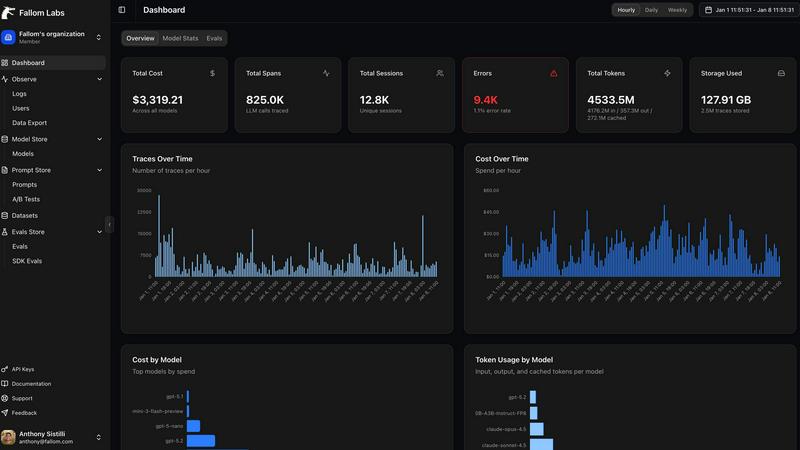
Fallom provides real-time observability for AI agents, enabling users to track every tool call and analyze timings. This feature allows engineering teams to debug with confidence and understand the performance of their AI systems through a live dashboard.
Cost Attribution
With Fallom's cost attribution feature, users can track spending per model, user, and team. This provides full transparency for budgeting and financial accountability, ensuring that organizations can effectively manage AI-related expenditures.
Compliance and Audit Trails
Fallom is built with compliance in mind, offering comprehensive audit trails that support regulatory requirements such as the EU AI Act, GDPR, and SOC 2. This feature includes input/output logging, model versioning, and user consent tracking to ensure that organizations meet their legal obligations.
Session Tracking and Grouping
The platform allows users to group traces by session, user, or customer to provide complete context. By organizing interactions in this way, teams can easily analyze user behavior and improve the overall performance of their AI agents.
OpenMark AI
Plain Language Task Description
Forget complex configuration files or scripting. OpenMark AI lets you start your benchmarking journey by simply describing the task you want to test in everyday language. Whether it's "extract dates and product names from customer emails" or "generate three creative taglines for a new coffee brand," you define the challenge naturally. The platform then helps you structure this into a validated benchmark, removing the technical barrier to rigorous testing and letting you focus on what matters: the task itself.
Multi-Model Comparison in One Session
The core of OpenMark's power is its ability to run your exact same prompt against dozens of leading models from providers like OpenAI, Anthropic, and Google simultaneously. You don't have to run separate tests, copy outputs between tabs, or manually calculate costs. In one unified session, you get side-by-side results, allowing for a direct, apples-to-apples comparison that reveals clear winners and surprising contenders for your specific use case.
Holistic Performance Metrics
OpenMark moves beyond simple accuracy. It provides a multi-dimensional report card for each model, including scored quality for your task, the actual cost per API request, response latency, and—importantly—stability metrics from repeat runs. This last feature shows you the variance in outputs, helping you identify models that are consistently good versus those that just got lucky once, which is critical for shipping reliable features.
Hosted Benchmarking with Credits
To streamline your exploration, OpenMark operates on a credit system, eliminating the need for you to obtain, configure, and manage separate API keys for every model provider you want to test. This hosted approach means you can start benchmarking immediately, with all the complexity handled in the background. It turns a multi-day setup process into a few clicks, making sophisticated model evaluation accessible to every developer and team.
Use Cases
Fallom
Customer Support Optimization
Organizations can use Fallom to optimize their customer support operations by gaining insights into AI interactions. This allows teams to identify common issues, improve response times, and enhance customer satisfaction through better AI performance.
Regulatory Compliance Management
With Fallom's comprehensive audit trails, companies can manage their compliance requirements effectively. This use case is particularly relevant for businesses operating in regulated industries, ensuring they adhere to necessary legal frameworks.
Debugging and Performance Tuning
Fallom enables engineering teams to debug complex AI agent workflows by visualizing timing waterfalls and tool calls. This helps in identifying bottlenecks and improving the efficiency of AI systems, leading to faster response times and better resource utilization.
Cost Management and Budgeting
By utilizing Fallom’s cost attribution feature, organizations can manage their AI-related expenditures more effectively. This use case allows for precise budgeting, cost forecasting, and financial planning, ensuring that AI investments yield maximum returns.
OpenMark AI
Validating a Model Before Feature Ship
A product team is weeks away from launching a new AI-powered summarization feature. They've shortlisted three models but need concrete data to make the final, responsible choice. Using OpenMark, they benchmark all three on their actual user prompts, comparing not just summary quality but also cost efficiency and consistency. The evidence guides them to the optimal model, de-risking the launch and ensuring a high-quality user experience from day one.
Cost-Efficiency Analysis for Scaling
A startup with a successful AI chatbot needs to optimize its growing inference costs. They suspect a smaller, cheaper model might perform adequately for most user queries. They use OpenMark to run their common question types against both their current premium model and several cost-effective alternatives. The side-by-side comparison of quality scores versus real API costs reveals the perfect balance, potentially saving thousands without degrading service.
Building a Reliable RAG Pipeline
A developer is constructing a Retrieval-Augmented Generation system for a knowledge base. The choice of the final LLM for synthesis is critical. They use OpenMark to test various models with complex, multi-document queries, focusing heavily on the stability metric across repeat runs. This helps them select a model that provides factual, consistent answers every time, which is far more valuable than a model that occasionally produces brilliance but often hallucinates.
Agent Routing and Orchestration Decisions
An engineering team is designing an AI agent that must route subtasks to different specialized models. They need to know which model is best for classification, which excels at data extraction, and which is most cost-effective for simple formatting. OpenMark allows them to create a suite of micro-benchmarks for each task type, building a data-driven routing map that optimizes both performance and budget across their entire agentic workflow.
Overview
About Fallom
Fallom is a cutting-edge AI-native observability platform designed to transform how organizations monitor and manage their customer-facing AI agents. In the complex landscape of AI operations, where even minor miscommunications can lead to customer dissatisfaction, Fallom offers a beacon of clarity. It addresses the black box problem of production AI by providing engineering teams with the tools they need to gain complete visibility into their large language model (LLM) and agent workloads. With Fallom, users can track every interaction, from prompts to model outputs, and analyze tool calls in real-time. This level of transparency not only enhances debugging and performance but also ensures compliance with industry regulations. Built for teams transitioning from experimental prototypes to full-scale deployments, Fallom empowers users to operate their AI applications with the confidence and reliability that is essential in today’s fast-paced digital landscape. The journey from uncertainty to mastery over AI operations starts here, with Fallom leading the way.
About OpenMark AI
Imagine you're building a new AI feature. You've read the spec sheets, you've seen the leaderboards, but a nagging question remains: which model is truly the best for your specific task? Not for a generic benchmark, but for the exact prompt, the precise nuance, the unique data you need to process. This is the journey OpenMark AI was built for. It's a web application that transforms the complex, technical chore of LLM benchmarking into a straightforward, narrative-driven exploration. You simply describe your task in plain language—be it classification, translation, data extraction, or RAG—and OpenMark runs the same prompts against a vast catalog of over 100 models in a single session. The magic happens when you compare the results. You see not just a single, lucky output, but a comprehensive view of scored quality, real API cost per request, latency, and, crucially, stability across repeat runs. This reveals the variance, showing you which models are consistently reliable. Built for developers and product teams making critical pre-deployment decisions, OpenMark eliminates the hassle of configuring separate API keys for every provider. With a hosted, credit-based system, you can focus on finding the model that delivers the right quality for your budget, ensuring your AI feature is built on a foundation of evidence, not guesswork.
Frequently Asked Questions
Fallom FAQ
What is Fallom?
Fallom is an AI-native observability platform that provides real-time insights into AI agent interactions, enabling engineering teams to monitor, debug, and optimize their AI operations with clarity and confidence.
How does Fallom ensure compliance with regulations?
Fallom includes comprehensive audit trails, input/output logging, model versioning, and user consent tracking, which collectively help organizations meet regulatory requirements such as GDPR and SOC 2.
Can Fallom be integrated with existing AI systems?
Yes, Fallom is built on an OpenTelemetry-native SDK, making it compatible with a wide range of AI providers. This allows users to integrate it seamlessly into their existing AI systems without vendor lock-in.
How does Fallom improve debugging for AI agents?
Fallom provides detailed visibility into every interaction, including timing waterfalls and tool call visibility. This information allows engineering teams to pinpoint issues, optimize performance, and ensure more effective AI interactions.
OpenMark AI FAQ
How does OpenMark ensure results are accurate and not cached?
OpenMark AI performs real, live API calls to each model provider during every benchmark run. The costs, latencies, and outputs you see are generated on-demand for your specific task. This guarantees you are comparing genuine, current performance data—the same experience you would have integrating the model directly—and not reviewing static, pre-computed marketing numbers that may not reflect real-world conditions.
What kind of tasks can I benchmark with OpenMark?
The platform is designed for a wide array of common and complex AI tasks. You can benchmark models for classification, translation, data extraction, question answering, research synthesis, image analysis, RAG (Retrieval-Augmented Generation) responses, agent routing logic, creative writing, and much more. If you can describe it in a prompt, you can likely build a benchmark for it.
Do I need my own API keys to use OpenMark?
No, one of the key conveniences of OpenMark is that it is a hosted benchmarking service. You operate using credits purchased or obtained through a plan. The platform manages all the underlying API connections to providers like OpenAI, Anthropic, and Google. This means you can start comparing models immediately without the administrative overhead of securing and configuring multiple keys.
Why is measuring stability or variance important?
A single test run can be misleading, as even the best models can occasionally produce a poor output, and weaker models can sometimes get lucky. By running your task multiple times and measuring variance, OpenMark shows you which models are consistently reliable. For shipping a production feature, consistency is often more critical than peak performance, as it builds user trust and ensures a predictable experience.
Alternatives
Fallom Alternatives
Fallom is an advanced observability platform specifically designed for AI applications. It empowers engineering teams to navigate the complexities of AI agent deployment by providing complete transparency into every interaction, from prompts to outputs. This clarity is crucial as teams transition from initial prototypes to fully operational systems where performance, reliability, and compliance become paramount. Users often seek alternatives to Fallom for several reasons, including pricing, specific feature sets, or unique platform requirements that align better with their organizational needs. When choosing an alternative, it's essential to consider factors such as the level of observability offered, ease of integration, compliance capabilities, and the ability to provide actionable insights that can enhance AI performance and user experience.
OpenMark AI Alternatives
Choosing the right LLM for your project is a critical, often frustrating, step. OpenMark AI is a developer tool designed to cut through that uncertainty by letting you benchmark over 100 models on your specific task, comparing real-world cost, speed, quality, and output stability in a single browser session. Developers and teams often explore alternatives for various reasons. Perhaps they need a solution that integrates directly into their CI/CD pipeline, requires a self-hosted option for data governance, or operates on a different pricing model. The needs of a solo builder differ from those of an enterprise team. When evaluating other tools in this space, focus on what matters for your workflow. Key considerations include whether the tool tests with live API calls or cached data, how it measures and scores output quality for your use case, its model catalog coverage, and how it handles the practicalities of API keys and cost transparency across providers.