
Crawlkit vs echoloc
Side-by-side comparison to help you choose the right product.

Crawlkit
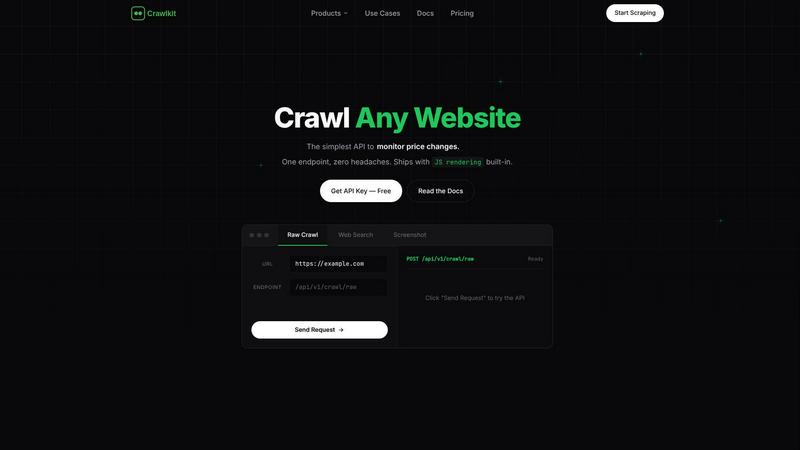
Turn any website into a structured API with a single, simple call.
Last updated: February 28, 2026

Echoloc finds companies ready to buy by turning their job posts into actionable sales signals.
Last updated: February 28, 2026
Visual Comparison
Crawlkit
echoloc
Feature Comparison
Crawlkit
One API for Every Data Source
Imagine having a universal key for every locked door on the web. Crawlkit provides exactly that—a single, consistent API endpoint to extract structured data from a diverse array of platforms. From professional networks like LinkedIn and social media giants like Instagram to app stores and search engines, you use the same simple request format. This eliminates the need to juggle multiple specialized scrapers or learn different protocols for each website, streamlining your entire data pipeline into one cohesive, manageable workflow.
Built-in Anti-Bot Evasion & Reliability
The journey for data is fraught with digital gatekeepers. Crawlkit acts as your expert navigator, automatically handling the complex challenges that break ordinary scrapers. It seamlessly rotates proxies to mimic organic traffic, employs headless browser rendering for JavaScript-heavy sites, and manages rate limits intelligently. This ensures your requests are successful and your data flow remains uninterrupted, providing complete, validated results without you ever worrying about the underlying technical skirmishes.
Developer-First SDK & Simplicity
Crawlkit is built with the developer's journey in mind. Getting started is a story of simplicity. With a straightforward SDK available for Node.js and a universal HTTP API, you can integrate powerful data extraction into your applications within minutes. The clear documentation and intuitive design mean you spend less time configuring tools and more time building the features that matter, using the clean, structured data delivered directly to your code.
Transparent, Credit-Based Pricing
Your expedition should be predictable, especially in cost. Crawlkit employs a clear, credit-based pricing model where you only pay for what you use, with costs known upfront for each API endpoint. Credits never expire, and there are no monthly commitments or hidden fees. This transparent approach, coupled with volume discounts, allows for precise budgeting and scalable growth, ensuring the path to more data is also a path to greater efficiency.
echoloc
Natural Language Search
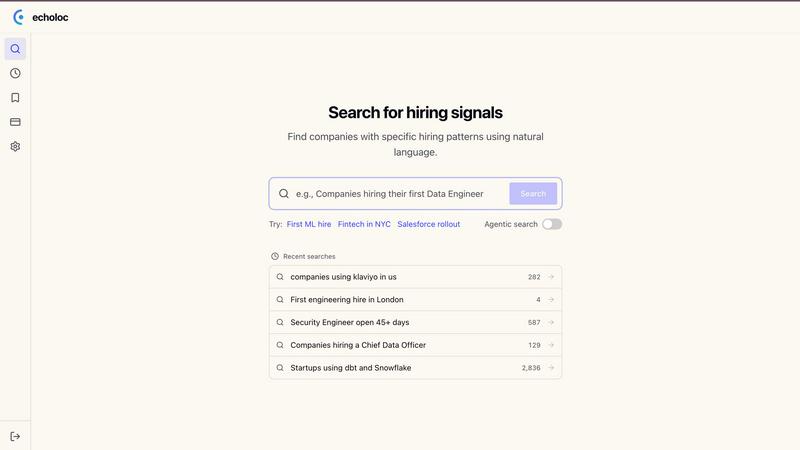
Forget complex Boolean strings and endless filter configurations. With echoloc, you search the way you think. Simply describe the signal you're hunting for in plain English, like "companies hiring their first ML engineer" or "fintech startups hiring 5+ engineers this month." The platform interprets your query and instantly surfaces the companies whose hiring activity matches your description, making powerful signal discovery intuitive and accessible to every team member without a steep learning curve.
Evidence-Based Results
Every company match in your results is accompanied by direct proof from the source. Instead of just seeing a company name, you get relevant snippets from the actual job descriptions that triggered the signal. This means you can see the phrase "building our data platform from scratch" or "migrating from HubSpot to Salesforce," providing undeniable context for your outreach and eliminating the guesswork from your prospecting process.
Real-Time Signal Database
The platform continuously monitors over 30 million companies and analyzes more than 10 million job posts, providing real-time updates on hiring activity. This ensures you are working with the freshest possible signals, not stale lists. You can see when a key role was last posted, allowing you to prioritize outreach to the most timely and relevant opportunities as they emerge in the market.
Curated Signal Templates
Jumpstart your search with pre-built, high-intent query templates designed to uncover the most valuable buying signals. Templates like "First Hire," "Hiring Spike," "Tech Stack," and "Geo Expansion" instantly filter the database for scenarios known to indicate budget creation, rapid scaling, specific tool investments, or new market entries, helping you quickly identify companies in pivotal, purchase-ready moments.
Use Cases
Crawlkit
CRM and Lead Enrichment
Transform your sales pipeline from a list of names into a rich narrative. Automatically enrich contact records in your CRM by pulling detailed professional data from LinkedIn. Populate fields with accurate job titles, company information, employee counts, and recent activity, giving your sales team deep context for personalized outreach and higher conversion rates, all without manual research.
Competitive Intelligence and Market Research
Stay ahead in the market by silently observing your competitors' digital footprints. Use Crawlkit to monitor competitors' Instagram engagement, track pricing changes on e-commerce sites, or analyze their app store reviews and ratings over time. This continuous stream of structured intelligence allows you to spot trends, identify weaknesses, and adapt your strategy with data-backed confidence.
Brand Monitoring and Social Listening
Protect and understand your brand's story as it unfolds online. Systematically gather public mentions, reviews, and social media posts related to your brand, products, or industry keywords from various platforms. Crawlkit turns the noisy social web into structured data, enabling you to analyze sentiment, measure campaign impact, and respond to customer feedback proactively.
Content and Product Strategy
Fuel your content and product development with real-world data. Extract trending topics from forums, analyze review themes for your and competing products, or gather public feedback from app stores. This direct line to user-generated content provides invaluable insights for creating relevant blog posts, improving product features, and making strategic decisions that resonate with your audience.
echoloc
Prospecting for Greenfield Opportunities
Identify companies making their first-ever hire in a critical function, such as a data engineer or security specialist. These "first hire" signals indicate a company is building a new capability from the ground up, representing a greenfield opportunity with no incumbent vendors. Your outreach can position your solution as the foundational partner for their new initiative, securing a foothold before competitors are even aware.
Capitalizing on Rapid Scaling
Target organizations experiencing a "hiring spike," where they are recruiting multiple roles in a single department within a short timeframe. This rapid scaling is a strong signal of increased funding, product-market fit, and immediate infrastructure needs. Sales teams can engage with confidence, knowing the company has both the urgent need and the budget to invest in solutions that support their explosive growth.
Targeting Tech Stack Migrations
Discover companies signaling a major platform change or rollout through job descriptions that mention specific tools or migration projects. For example, a role requiring experience in "migrating from HubSpot to Salesforce" directly reveals an active Salesforce implementation project. This allows vendors of complementary apps, consulting services, or training to engage with perfect timing and relevant messaging.
Engaging New Budget Owners
Pinpoint companies hiring for new leadership positions, such as a Chief Data Officer or VP of Sales. A new executive hire often signifies a reorganization of budgets and strategic priorities, creating an opening for new vendor relationships. This use case allows you to connect with fresh decision-makers who are actively evaluating their tech stack and looking to make an impact with new partnerships.
Overview
About Crawlkit
In the vast digital landscape, data is the new currency, but extracting it often feels like a perilous expedition. Developers and data teams embark on this journey, only to be met with the formidable obstacles of anti-bot walls, rotating proxies, and the intricate dance of headless browsers. This is where the story of Crawlkit begins. It is not just another web scraping tool; it is a powerful web data extraction platform designed to be your trusted guide through this complex terrain. Crawlkit transforms the web into a simple, unified API, allowing you to bypass the technical maze and go straight to the treasure: structured, actionable data. Whether you're seeking real-time price monitoring, enriching CRM profiles from LinkedIn, tracking social media growth on Instagram, or analyzing app store reviews, Crawlkit handles the arduous process of collection. It meticulously manages proxy rotation, browser rendering, and platform-specific parsing, ensuring you receive clean, complete, and reliable data with a single API call. For businesses and builders who wish to harness the power of web data without getting lost in the infrastructure, Crawlkit is the compass that points directly to insight, turning the chaotic web into a streamlined, accessible API.
About echoloc
Imagine being the first salesperson to know a company is about to make a major purchase. Not through a rumor or a late-stage intent signal, but by seeing the blueprint of their ambition laid bare in a public job posting. This is the journey echoloc empowers. Echoloc is a hiring signals platform that transforms the noise of job boards into a crystal-clear map of future buyer intent. It’s built for the modern revenue team—the SDRs, AEs, and leaders who are tired of chasing crowded deals and want to discover opportunities at their inception. The core belief is simple: a company posting a job for its first data engineer, scaling a sales team by eight, or hiring a Chief Data Officer isn't just adding headcount; they are leaking their strategic plans and budget allocations. Echoloc scans, analyzes, and structures millions of job posts in real-time, turning them into searchable, actionable signals. This allows you to reach out with context and relevance at the precise moment a company is formulating a need, long before that need appears on a review site or an intent data platform. Your edge is no longer just who you target, but when you find them.
Frequently Asked Questions
Crawlkit FAQ
What platforms can I scrape with Crawlkit?
Crawlkit is designed as a versatile platform for structured data extraction. It offers dedicated, pre-built APIs for major platforms like LinkedIn, Instagram, Google Play Store, and Apple App Store. Furthermore, the team is committed to expansion; if you need an API for a specific website or platform they don't yet support, you can contact them, and they will work to build it for you.
How does Crawlkit handle websites with anti-bot protection?
Crawlkit is engineered to navigate these challenges automatically. The system employs a sophisticated combination of residential proxy rotation to distribute requests, full headless browser rendering to execute JavaScript just like a real user, and intelligent request pacing. This multi-layered approach maximizes success rates, allowing you to collect data from even the most protected sites reliably.
Do I need to manage proxies or browsers myself?
No, that's the core value of the journey with Crawlkit. All the complex infrastructure—including proxy management, browser automation, CAPTCHA solving, and HTML parsing—is fully managed by the Crawlkit platform. You simply make an API call specifying what data you want and from where, and Crawlkit delivers the clean, structured result, handling all the hard parts behind the scenes.
What happens if a request fails?
Crawlkit operates on a "refund on failure" policy. If an API request is unsuccessful and does not return the requested structured data, the credits used for that attempt are automatically refunded to your account. This ensures you only pay for successful data delivery, aligning the platform's success directly with your own.
echoloc FAQ
What kind of signals can I find with echoloc?
Echoloc is designed to uncover a wide range of high-intent buying signals from job posts. Key categories include First Hires (e.g., first data engineer), Hiring Spikes (rapid team expansion), Tech Stack Mentions (companies using or migrating to specific tools), New Leadership hires (like a Chief Data Officer), Geo Expansion (first hire in a new region), and Urgent Pain (roles open for 45+ days). You can search for these using curated templates or your own natural language queries.
How current is the data in the platform?
The data is updated in real-time. The platform continuously monitors job boards and company pages, analyzing over 10 million jobs across 30 million companies. Each result in your search shows a "last seen" timestamp, so you know exactly how fresh the signal is. This ensures you are reaching out based on the most recent hiring activity, not outdated information.
Do I need technical skills to use the search?
Not at all. Echoloc is built for revenue professionals, not data scientists. The core feature is a natural language search that allows you to type queries as you would describe them to a colleague, such as "startups using dbt and Snowflake." There is no need to learn complex query syntax or Boolean logic, making powerful signal discovery accessible to everyone on your sales team.
How does echoloc differ from traditional intent data?
Traditional intent data often tracks later-stage signals like website visits, content downloads, or review site activity—by then, a company is already researching solutions and your competitors are likely already engaged. Echoloc focuses on earlier, foundational signals found in hiring plans. A job post for a new team or project often precedes any public research, allowing you to identify and engage a buyer who is forming a need, giving you a significant timing advantage.
Alternatives
Crawlkit Alternatives
In the world of data-driven decisions, tools like Crawlkit serve as vital bridges to the vast information on the web. As a developer-centric platform in the analytics and data category, it transforms the complex task of web scraping into a streamlined process for gathering insights and monitoring changes. Yet, every project has its own unique journey, and the path that works for one team may not be the perfect fit for another. Users often begin searching for different tools when their needs evolve. Perhaps a project demands a specific feature not yet available, or budget constraints require a different pricing model. Others might seek a platform that aligns more closely with their existing tech stack or offers a different balance between simplicity and advanced control. It’s a natural part of finding the right tool for your specific data expedition. When evaluating other options, consider the core of your mission. Look for reliability in handling modern website protections, the scalability to grow with your data demands, and the clarity of an API that lets you focus on insights, not infrastructure. The goal is to find a companion that removes roadblocks, allowing you to navigate the web's data landscape with confidence and ease.
echoloc Alternatives
Echoloc is a powerful tool in the sales intelligence category, designed to help revenue teams discover new opportunities by analyzing job postings for concrete buying signals. It’s a journey that begins with a simple insight: a new job description often signals a company's next major investment. Sales professionals might explore other paths for various reasons. Perhaps their budget requires a different pricing model, or their workflow demands integration with specific platforms. Others might seek a broader set of features beyond job post analysis to fuel their prospecting engine. When evaluating different solutions, consider the core intelligence source. Does it provide unique, early-stage signals? Assess how it fits into your daily workflow and whether it delivers actionable insights that feel timely and relevant, turning data into genuine conversations.