
Collab Chain vs Interactive Circle of Fifths
Side-by-side comparison to help you choose the right product.

Turn your royalty statements into verifiable proof of ownership and collaboration.
Last updated: February 28, 2026

Interactive Circle of Fifths
Embark on a musical journey to unlock scales, chords, and harmonies with this interactive guide.
Last updated: March 1, 2026
Visual Comparison
Collab Chain

Interactive Circle of Fifths
Feature Comparison
Collab Chain
Deterministic Proof from Official Statements
Your journey to clarity starts with your official paperwork. Collab Chain accepts PDF or CSV exports directly from your distributors, publishers, and PROs. We preserve your original file in its entirety and use it to generate a deterministic, tamper-evident snapshot of your royalties. This means the proof we create can be independently verified at any point in the future, providing an immutable record based solely on the documents you provided, not on estimates or scraped data.
Unmissable Split Confirmation & Validation
Navigating collaborator splits is a critical part of the journey. Collab Chain provides clear, track-level status indicators—showing Complete, Incomplete, or Not Set—so you can see your progress at a glance. The platform enforces that all splits must total 100% and prevents you from finalizing a proof until every collaborator's share is confirmed. This built-in validation acts as a safeguard, ensuring no contributor is accidentally omitted from the record.
Secure, Read-Only Proof Sharing
Sharing your success should not mean sharing your account access. Once a proof is locked, you can generate secure, read-only verification links. Share these with collaborators, managers, or legal teams, allowing them to view the proof summary and details without needing a Collab Chain account and without any ability to edit the information. It’s transparency on your terms, fostering trust without compromising security.
Organized Supporting Evidence
We understand that sometimes the official export isn't available. For those moments, you can upload PNG or JPG screenshots from dashboards as Supporting Evidence. These files are never parsed for calculations; they are clearly labeled as "Not an Official Statement" and displayed separately in exports. This feature ensures your narrative remains complete, providing crucial context while maintaining a clear distinction between verifiable proof and supplementary information.
Interactive Circle of Fifths
Dynamic Circle Visualization
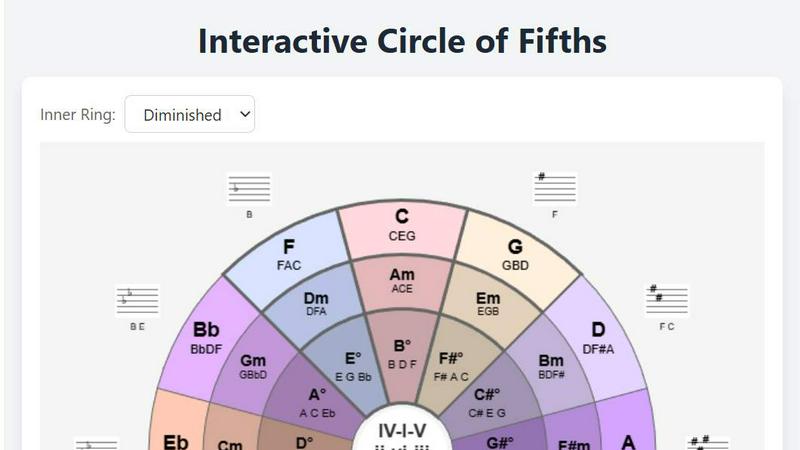
At the heart of the tool is the interactive circle itself. Click on any key, and watch as the entire interface updates in real-time. The outer ring displays the harmonized chords for that key (like C, Dm, Em), while the inner ring allows you to layer on various scales such as Pentatonic, Blues, or Diminished. This dynamic visualization turns the theoretical circle into a practical playground, showing you exactly which notes and chords belong together in any musical context you choose to explore.
Harmonized Scale & Chord Sequencer Panel
This powerful panel displays the seven chords that naturally occur in any selected key, complete with their Roman numeral analysis (I, ii, iii, etc.). It’s your instant songwriting and analysis hub. You can click on each chord to hear it, understanding its unique color and function. Furthermore, it acts as a chord sequencer, allowing you to build and audition common progressions (like I-V-vi-IV) to hear how chords tell a story and resolve to create movement and emotion in your music.
Multi-Instrument Fretboard & Keyboard
Understanding theory is one thing; applying it to your instrument is another. This feature provides instant, synchronized diagrams for both piano keyboard and guitar fretboard. When you select a chord or scale, the tool highlights the corresponding notes and positions on these instruments. This bridges the gap between intellectual knowledge and physical play, helping you translate what you see on the circle directly to your fingers, accelerating your learning and improvisation skills.
Scale Degree & Resolution Guide
Go beyond just naming chords and understand their role in a musical story. For each chord in the harmonized scale, the tool clearly labels its scale degree and its typical "Resolves To" function. This teaches you the gravitational pull within a key—why the V chord desperately wants to go to the I, or how a ii chord sets up a V. This insight is crucial for composing compelling progressions and for improvisers who want to target notes that create satisfying melodic resolution.
Use Cases
Collab Chain
The Independent Artist Managing Multiple Collaborations
An independent singer-songwriter consistently works with different producers and co-writers across various projects. Using Collab Chain, they upload each royalty statement as it arrives, confirm the agreed splits with each collaborator, and lock a permanent proof. This creates an organized, searchable ledger of their entire catalog's earnings, eliminating confusion and building a foundation of trust that makes future collaborations smoother and more secure.
The Producer Establishing Credit for Catalog Value
A producer looking to sell their catalog or secure financing needs indisputable proof of their contributions and earnings. They use Collab Chain to compile years of statements from various artists and labels, generating verifiable proofs for every track they worked on. This aggregated, tamper-evident portfolio becomes a powerful asset for negotiations, clearly demonstrating their historical value and revenue share to potential buyers or investors.
The Songwriter in a Publishing Dispute
A songwriter finds a discrepancy in their publishing royalties for a hit song. Instead of relying on fragmented emails and memory, they use Collab Chain to present the original distributor statement and the locked proof showing the agreed writer splits. This provides a clear, defensible, and neutral record to resolve the dispute efficiently with their publisher or PRO, turning a stressful conflict into a straightforward verification process.
The Artist Manager Streamlining Roster Operations
A manager overseeing a roster of ten artists is inundated with statements from multiple sources. They use Collab Chain as a centralized command center, uploading statements for each artist, confirming splits, and maintaining a clear archive. When an artist needs to provide proof of earnings for a visa application or a brand partnership, the manager can instantly generate and share a verified proof, saving countless hours of administrative work.
Interactive Circle of Fifths
Songwriting & Chord Progression Discovery
Stuck in a creative rut? Songwriters can use the tool to break free from familiar patterns. By exploring the harmonized scale panel, you can experiment with non-diatonic chords from related keys or use the chord sequencer to build and hear new progressions instantly. It helps you find that perfect chord that adds surprise or emotional depth, turning a simple melody into a complete, harmonically rich composition.
Music Theory Learning & Tutoring
For students and teachers, this tool is an invaluable educational asset. It makes abstract concepts tangible. A teacher can demonstrate how changing the key shifts all relationships, or how a Blues scale overlays on a standard progression. Students can interactively test their knowledge, seeing and hearing the results of their choices, which reinforces learning far more effectively than a textbook diagram ever could.
Instrument Practice & Improvisation
Practicing musicians can use it as a focused practice companion. A guitarist can select a key and the "Blues Scale" overlay to see the exact fretboard patterns for a 12-bar blues in that key. A pianist can explore the "Diminished Chord" functions to practice passing chords. It provides a structured yet creative framework for scale runs, arpeggio practice, and developing melodic ideas that are firmly rooted in the song's harmony.
Music Analysis & Appreciation
Deepen your listening experience by analyzing your favorite songs. When you hear a captivating chord change, you can use the tool to find the key and identify the borrowed chord or modulation the artist used. Understanding that a song uses a iv chord from the parallel minor, for example, adds a new layer of appreciation for the craft behind the music you love.
Overview
About Collab Chain
Every artist's journey is a tapestry woven from countless collaborations, late-night sessions, and shared creative sparks. Yet, when the music is released into the world, that beautiful process often collides with a complex reality of opaque statements, uncertain splits, and fragile trust. Collab Chain is the companion for that next chapter, built to bring clarity and confidence where confusion once reigned. It is a dedicated platform for verifiable royalty proof, designed for creators, producers, songwriters, and rights holders navigating the intricate landscape of music ownership. Your journey with us begins not with guesswork, but with the official documents you already possess—statements from distributors, PROs, and publishers. We transform this often-impenetrable paperwork into a clear, structured, and tamper-evident record of truth. Think of it as a secure "credit locker" for your career, a single source of truth that reduces disputes, fosters transparency among your collaborators, and provides defensible proof for negotiations, audits, or resolving conflicts. Collab Chain doesn't pull live data or send payments; it empowers you to prove what you've earned, turning the opaque into the undeniable and ensuring every contributor's role in your story is recognized and respected.
About Interactive Circle of Fifths
Imagine unlocking a map to the entire world of music, where every chord, scale, and progression is connected by a beautiful, logical pattern. This is the journey the Interactive Circle of Fifths invites you on. It's more than a static diagram; it's a living, breathing musical companion designed for anyone whose heart beats to the rhythm of creation—from the curious beginner taking their first steps into music theory to the seasoned composer seeking fresh inspiration. This tool transforms the abstract concepts of harmony into an intuitive visual and auditory experience. By simply selecting a key, you can see and hear the intricate relationships between chords, explore how they naturally resolve, and discover the scales that give them color. Its core value lies in demystifying music theory, making the profound connections that underpin all Western music accessible and engaging. Whether you're deciphering the emotional pull of a chord progression, writing a new song, or improvising a solo, the Interactive Circle of Fifths is your guide, illuminating the path through the rich landscape of keys, scales, and harmonies.
Frequently Asked Questions
Collab Chain FAQ
What kind of files does Collab Chain accept?
Collab Chain is built for verifiable proof, which starts with official documents. We accept PDF or CSV export files directly from your music distributors (like DistroKid, CD Baby), publishers, and Performing Rights Organizations (PROs like ASCAP, BMI). These form the basis of your locked proof. For additional context when an official export isn't available, you can upload screenshot images (PNG/JPG) as clearly labeled Supporting Evidence.
Does Collab Chain pull my live streaming data or send payments?
No. Collab Chain does not connect to or scrape streaming service dashboards like Spotify for Artists. We do not pull live earnings data or handle any payments. Our sole purpose is to help you prove what you've already been officially reported as earning. You upload your existing statements, and we help you structure, verify, and lock that information into an indisputable record.
What happens after I "lock" a proof?
Locking a proof is the final step in creating a permanent, verifiable record. Once locked, the core data from your original statement and the confirmed splits cannot be altered. This ensures the proof's integrity. You can then download it as a PDF or export bundle for your records and generate secure, read-only links to share it. Supporting evidence can be added later but is always marked as such to preserve the proof's original state.
How does Collab Chain ensure my data is secure and private?
Your data sovereignty is central to our mission. We preserve your original uploaded files exactly as you provide them. The proofs we generate are deterministic, meaning their verification is based solely on that original data. We do not guess, estimate, or mutate your information. Your files and proofs are stored securely, and sharing is always under your control via read-only links that do not grant account access.
Interactive Circle of Fifths FAQ
Is the Interactive Circle of Fifths suitable for complete beginners?
Absolutely. The tool is designed to guide beginners on their musical journey. It starts with simple, clear visualizations of major keys and basic chords. By clicking and hearing the relationships, you learn intuitively. The integrated piano and guitar diagrams help you connect the theory directly to your instrument, making it an ideal starting point for grasping foundational concepts without overwhelming jargon.
Can I use this tool for genres outside of classical or jazz, like pop or rock?
Yes, definitively. The principles of the Circle of Fifths and diatonic harmony are the foundation of most Western music, including pop, rock, blues, and country. The included scales like Pentatonic and Blues are essential for these genres. The tool helps you understand the chord progressions that power countless hit songs and provides the scale knowledge needed for crafting iconic guitar solos and riffs.
How does the "Resolves To" feature help me as a musician?
The "Resolves To" feature teaches you about musical tension and release—the engine of emotion in music. Knowing that the V chord (dominant) naturally resolves to the I (tonic) helps you create satisfying endings. Understanding secondary resolutions (like vi going to ii or V) allows you to build more nuanced and interesting progressions, giving your compositions a professional sense of direction and flow.
Do I need to be able to read sheet music to use this tool?
No, reading standard sheet music is not required. The tool communicates visually with the circle and instrument diagrams, and auditorily with direct sound feedback. You learn by seeing relationships on the circle, hearing the chords and scales, and mapping them to your instrument's layout. It’s a practical, application-focused approach to music theory.
Alternatives
Collab Chain Alternatives
Collab Chain is a journey towards clarity, a productivity tool designed to transform the complex paperwork of music royalties into verifiable proof of ownership. It belongs to a category of solutions built for creators who seek to bring order and trust to the collaborative process, turning statements into a structured, defensible record of contribution. Artists often explore different paths on this journey for various reasons. Some may be looking for a different pricing structure or a specific feature set that aligns with their workflow. Others might need a platform that integrates with a particular set of tools or caters to a different creative industry altogether. The search for the right fit is a natural part of finding the tool that best supports your unique story. When considering other routes, focus on the core destination: verifiable truth. Look for solutions that prioritize data integrity, enforce clear collaboration rules, and provide a transparent audit trail. The right tool should not just store data, but actively help you build an undeniable, structured narrative of ownership that stands the test of time and scrutiny.
Interactive Circle of Fifths Alternatives
Every musician's journey is unique, and the path to mastering theory is paved with different tools. The Interactive Circle of Fifths is a comprehensive digital guide in the education and learning space, designed to illuminate the relationships between keys, chords, and scales through an immersive blend of sight and sound. It’s a companion for those eager to explore music's foundational language. Yet, every traveler may seek a different map. Some may be looking for a simpler starting point, a different pricing model, or a tool tailored to a specific instrument or platform. The quest for an alternative often stems from a desire to find the perfect fit for one’s individual learning style, budget, or creative workflow. When searching for a different guide on your musical journey, consider what truly fuels your progress. Look for a tool that resonates with your primary instrument, offers the depth of theory you wish to explore, and provides a learning experience—be it visual, auditory, or hands-on—that keeps you engaged and moving forward.