
Agenta vs Local Tools
Side-by-side comparison to help you choose the right product.

Agenta unifies your team's journey from scattered prompts to reliable, collaborative LLM applications.
Last updated: March 1, 2026

Local Tools
Discover and use thousands of private, browser-based tools that run directly on your device with no installs or tracking.
Last updated: April 4, 2026
Visual Comparison
Agenta
Local Tools
Feature Comparison
Agenta
Unified Playground & Experimentation
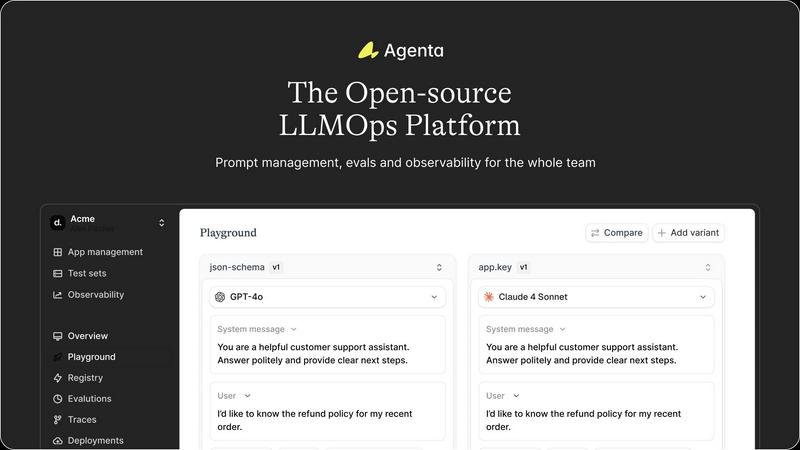
Agenta provides a central, model-agnostic playground where your team can safely experiment with different prompts, parameters, and models from any provider side-by-side. This eliminates the need for scattered scripts and documents. Every iteration is automatically versioned, creating a complete history of your experiments so you can track what changed, why, and its impact. Found a problematic output in production? You can instantly save it as a test case and begin debugging right in the same interface.
Systematic Evaluation Framework
Move beyond "vibe testing" with Agenta's robust evaluation system. It allows you to create a systematic process to run experiments, track results, and validate every change before deployment. The platform supports any evaluator you need—LLM-as-a-judge, custom code, or built-in metrics. Crucially, you can evaluate the full trace of an agent's reasoning, not just the final output, and seamlessly integrate human feedback from domain experts into the evaluation workflow.
Production Observability & Debugging
When your LLM app is live, Agenta gives you clear visibility. It traces every user request, allowing you to pinpoint the exact step where failures occur. You and your team can annotate these traces to discuss issues or gather user feedback directly. With a single click, any problematic trace can be turned into a test case, closing the feedback loop. Live, online evaluations monitor performance continuously to detect regressions as they happen.
Collaborative Workflow for Whole Teams
Agenta breaks down silos by providing tools for every team member. It offers a safe, no-code UI for domain experts to edit and experiment with prompts. Product managers and experts can run evaluations and compare experiments directly from the UI, while developers work via a full-featured API. This parity between UI and API creates one central hub where everyone collaborates on experiments, versions, and debugging with real data.
Local Tools
Curated, Browser-First Directory
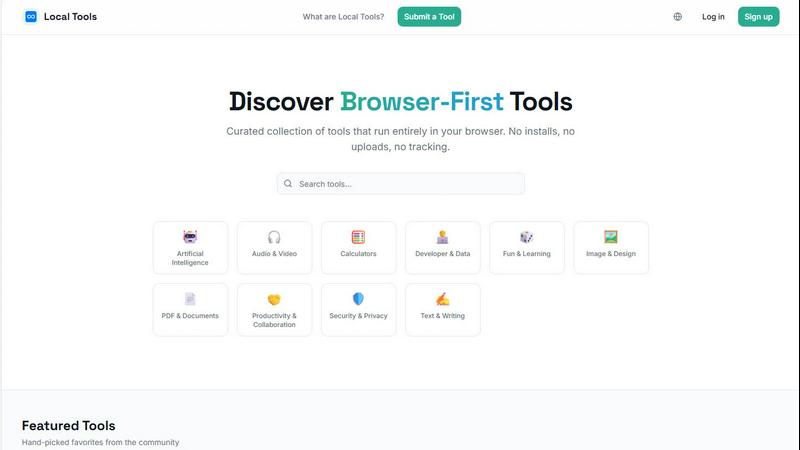
Local Tools is not a random aggregation of links; it is a thoughtfully curated collection of over a thousand utilities that are verified to run client-side in your browser. Each tool is categorized—like Image & Design, Developer & Data, or Security & Privacy—creating a structured, navigable library. This curation ensures quality and functionality, saving you from the repetitive and often low-quality alternatives scattered across the web. It’s your map to the best on-device tools available.
Complete Privacy & On-Device Processing
The core promise of Local Tools is uncompromising privacy. Every tool listed operates locally on your machine. Your files, data, and activities never get uploaded to external servers for processing. This means no risk of third-party data mining, no tracking of your usage patterns, and no reliance on an internet connection for the core functionality. It’s a secure, self-reliant way to work, giving you full control and peace of mind.
Streamlined Discovery & Comparison
Finding the right tool for a specific job can be a journey of endless tabs and bookmarks. Local Tools ends that hunt. By bringing thousands of utilities under one roof and organizing them by category and community ratings, it allows for effortless exploration and side-by-side comparison. You can quickly see user ratings, descriptions, and functionalities to choose the most suitable option without ever leaving the platform.
Community-Driven Curation & Submission
The directory is alive and grows through its community. Users can submit new browser-based tools they discover, contributing to the ever-expanding resource. This community-driven model, combined with featured "hand-picked favorites," ensures the collection stays current, diverse, and rich with high-quality, practical utilities that real people find useful in their daily digital journeys.
Use Cases
Agenta
Streamlining Enterprise Chatbot Development
A financial services company is building a customer support chatbot. Their domain experts, compliance officers, and developers need to collaborate tightly. Using Agenta, they centralize prompt versions, run evaluations against regulatory compliance checklists and customer intent accuracy, and observe live interactions to quickly debug hallucinations or incorrect advice, ensuring a reliable and compliant final product.
Building and Tuning Complex AI Agents
A team is developing a multi-step research agent that searches the web, summarizes findings, and generates reports. Debugging is a nightmare when only the final output is wrong. With Agenta, they evaluate each intermediate step in the agent's reasoning chain, identify which tool call failed, and use the unified playground to iteratively fix the prompt for that specific step, dramatically improving the agent's reliability.
Managing Rapid Product Iteration with LLMs
A product team at a SaaS company uses LLMs to generate personalized email content. Marketing wants to test new tones, while engineers worry about stability. Agenta allows them to A/B test different prompt variations systematically, gather quantitative scores on engagement metrics and qualitative feedback from the sales team, and confidently deploy the winning variant with full version control and rollback capability.
Academic Research and Model Benchmarking
A research lab is comparing the performance of various open-source and proprietary LLMs on a new benchmark task. They use Agenta's model-agnostic playground to run the same prompt templates across all models, automate scoring using custom evaluation scripts, and maintain a rigorous, reproducible record of all experiments and results in one platform, streamlining their publication process.
Local Tools
The Designer's Instant Editing Studio
A graphic designer receives a last-minute request to convert a batch of SVG files to WebP and quickly remove a background from a product shot. Instead of launching heavy software or trusting sensitive client assets to an unknown website, they visit Local Tools. Within moments, they find dedicated, browser-based converters and an editor like Photopea—a Photoshop alternative—all running locally. The work is done swiftly, privately, and without any installs, keeping their creative flow uninterrupted.
The Developer's Quick Utility Belt
A developer debugging an API response needs to visualize a complex JSON object. They could write a script or search for a standalone app. Instead, they head to Local Tools, find JSON Crack in the Developer & Data section, and paste their code. The data instantly transforms into an interactive graph right in their browser, aiding debugging. Later, they might use a text diff checker or a code formatter from the same hub, all without context-switching to different sites.
The Student's Secure Research Companion
A student working on a thesis needs to merge several PDF articles, count words across multiple documents, and protect their final submission with a password. Concerned about privacy and unwilling to upload academic work to random online services, they use Local Tools. They find all the necessary PDF utilities that process files directly on their laptop, ensuring their research remains confidential while completing essential formatting tasks efficiently.
The Everyday User's Privacy-Conscious Toolkit
Anyone planning their finances can use a salary calculator; someone formatting a resume can use a bullet point generator; a hobbyist can optimize images for a blog with Squoosh. For these everyday tasks, Local Tools provides a trustworthy, ad-free alternative to sketchy websites. Users accomplish their goals without the overhead of software installation or the unease of data tracking, making digital life simpler and more secure.
Overview
About Agenta
The journey of building with large language models is often a tale of chaos. Prompts are scattered across emails and Slack threads, experiments are launched on gut feeling, and debugging a failure in production feels like searching for a needle in a haystack. This is the unpredictable reality most AI teams face, where brilliant ideas get lost in siloed workflows and unreliable deployments. Agenta emerges as the guiding path through this wilderness. It is an open-source LLMOps platform designed to be the single source of truth for teams building reliable LLM applications. Agenta transforms the fragmented process into a structured, collaborative journey. It brings developers, product managers, and domain experts together into one unified workflow, allowing them to experiment with prompts, run systematic evaluations, and observe application behavior in production—all from a centralized platform. By replacing guesswork with evidence and silos with collaboration, Agenta empowers teams to iterate quickly, validate every change, and ship AI products you can truly trust.
About Local Tools
Imagine a digital workshop where every tool you need is laid out on a clean, organized bench, ready to use instantly without any setup. This is the journey Local Tools invites you on. It's more than just a website; it's a curated hub, a sanctuary for anyone who values speed, privacy, and simplicity in their digital tasks. In a world where our data is constantly in transit, Local Tools offers a different path: a collection of thousands of utilities that run entirely within your browser. No software to install, no files to upload to distant servers, and no hidden trackers monitoring your clicks. Everything happens right on your device, turning your browser into a powerful, self-contained workstation.
Built for the curious and the practical—developers tweaking code, designers perfecting an image, students analyzing data, or professionals managing documents—Local Tools simplifies discovery. Instead of wandering the fragmented web, searching for a trustworthy image converter or a secure PDF editor, you arrive at a single, organized directory. It’s structured by function, from AI and audio editing to text writing and security, making it easy to explore, compare, and find the perfect tool for the moment. It’s about reclaiming your workflow, ensuring your creations and data never leave your side, and uncovering hidden gems you might never have found on your own. Your journey to efficient, private computing starts here.
Frequently Asked Questions
Agenta FAQ
Is Agenta really open-source?
Yes, Agenta is a fully open-source platform. You can dive into the codebase on GitHub, self-host it on your own infrastructure, and contribute to its development. This ensures transparency, avoids vendor lock-in, and allows for deep customization to fit your specific LLMOps workflow and security requirements.
How does Agenta handle data privacy and security?
As an open-source platform, Agenta gives you full control over your data. You can deploy it within your private cloud or on-premise environment, ensuring that all prompts, evaluation data, and production traces never leave your network. This is crucial for enterprises in regulated industries like healthcare, finance, or legal services.
Can I use Agenta with my existing LLM framework?
Absolutely. Agenta is designed to be framework-agnostic. It seamlessly integrates with popular frameworks like LangChain and LlamaIndex, and it works with any model provider (OpenAI, Anthropic, Cohere, open-source models via Ollama, etc.). You can bring your existing applications and connect them to Agenta for the management, evaluation, and observability features.
Who on my team should use Agenta?
Agenta is built for the entire LLM application team. Developers use the API and SDK for integration, product managers and domain experts use the no-code UI to run evaluations and tweak prompts, and AI leads use the platform to oversee the entire experimentation lifecycle and production health. It bridges the gap between technical and non-technical stakeholders.
Local Tools FAQ
How does Local Tools ensure my privacy?
Local Tools is a directory, not a processor. We list tools that are built to run entirely within your web browser. This means when you use a tool like Photopea or a PDF converter, your files and data are processed directly on your computer's hardware. They are never uploaded to our servers or the tool creator's servers (unless the tool itself states otherwise). We prioritize listing tools that adhere to this client-side principle, giving you a privacy-first experience.
Do I need to create an account to use the tools?
No, you do not need an account to browse the Local Tools directory or to use the vast majority of tools listed. The tools themselves are external websites, and most are designed to be used immediately without sign-ups. An account on Local Tools is only needed if you wish to participate in the community by rating tools or submitting new ones to the directory.
Are the tools on Local Tools completely free to use?
Local Tools features a wide variety of utilities, and the pricing model is set by each tool's developer. Many of the tools listed, such as Squoosh, Photopea, and Excalidraw, are free to use. Some may offer premium features or subscriptions. Each tool's listing will direct you to its official website where you can find specific details about its cost, if any.
How can I suggest a new tool to be added to the directory?
We welcome and rely on community contributions! If you've found a fantastic browser-based tool that runs locally and isn't yet in our directory, you can submit it for review. Simply click the "Submit a Tool" link in the website's navigation. Our team will review the submission to ensure it meets our criteria for quality, functionality, and privacy before adding it to the curated collection.
Alternatives
Agenta Alternatives
Agenta is an open-source LLMOps platform, a specialized tool designed to streamline the complex journey of building and deploying large language model applications. It brings order to the often chaotic process by centralizing prompts, evaluations, and collaboration in one place. Teams often explore the landscape for alternatives driven by unique needs. This could be due to specific budget constraints, a requirement for different feature sets, or the need to integrate with an existing company tech stack. The search for the right tool is a common step in any team's evolution. When evaluating options, focus on what will best support your team's specific journey. Key considerations include the platform's ability to foster collaboration, its approach to testing and observability, and how well it integrates into your current workflow to reduce friction and accelerate development.
Local Tools Alternatives
Local Tools is a unique browser-first directory for utilities that run entirely on your device. It belongs to the category of on-device tool platforms, offering a curated, private, and instant way to access thousands of useful applications without installation or data uploads. People explore alternatives for various reasons. Some may seek different organizational structures, a broader or more niche set of tool categories, or platforms integrated with specific workflows. Others might prioritize community features, different discovery methods, or simply want to compare what else exists in this innovative space. When evaluating other options, consider your core needs. Look for a platform's commitment to privacy and local execution, the depth and quality of its curated tool collection, and how intuitively it helps you discover the right utility for your task. The best choice aligns with your desire for convenience, security, and a streamlined workflow.