
TaleHug AI Story Generator for Kids
Turn a child's voice, drawing, or idea into a safe, illustrated AI storybook for cozy co-reading adventures.
Visit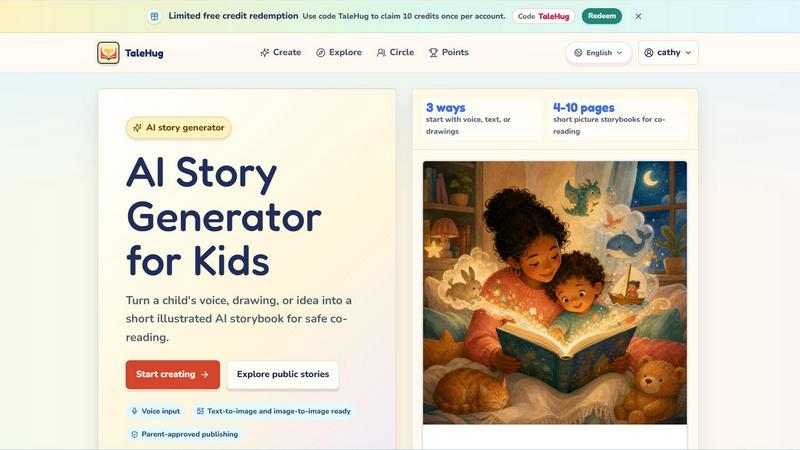
About TaleHug AI Story Generator for Kids
TaleHug is an AI-powered storytelling tool designed specifically for children, transforming their imagination into beautifully illustrated short storybooks. This platform invites young creators, typically between the ages of three and six, to step into the role of author and illustrator, guided by friendly AI assistance every step of the way. Instead of staring at a blank page, a child can simply speak an idea into the microphone, upload a drawing they have already made, or choose from a library of parent-approved story prompts. The AI then brings that spark to life, generating four to ten pages of cohesive narrative with vibrant, colorful illustrations that match the child's original vision. TaleHug is built for co-reading, meaning the resulting storybooks are short enough for a parent and child to enjoy together during a bedtime routine or a quiet afternoon. The platform places a heavy emphasis on safety and privacy, ensuring that every creation starts as a private draft. Any move to share a story with a wider circle or the public gallery requires adult review and approval. This thoughtful design makes TaleHug more than just a toy; it is a gentle introduction to creative writing, visual storytelling, and the responsible use of AI technology for young minds.
Features of TaleHug AI Story Generator for Kids
Three Ways to Start a Story
Children are not limited to typing out a full idea. TaleHug offers three distinct entry points for creativity. A child can use their voice to describe a character or a scene, and the AI will capture the essence of that spoken idea. Alternatively, they can upload a physical drawing they have made, and the AI will interpret the artwork to create a story around it. Finally, the platform provides a selection of parent-approved prompts for those moments when a child needs a gentle nudge to get started.
AI Generated Picture Storybooks
The core output of TaleHug is a short picture storybook, typically ranging from four to ten pages. Each page is generated with a strong, colorful illustration and a single, simple sentence that is easy for a young reader to follow. The AI stores the prompt used for each image, allowing the child or parent to easily regenerate a page if they want a different artistic style or a slightly different scene. This feature ensures the final book feels truly collaborative.
Parent Approved Publishing
Safety is a foundational feature of TaleHug. All newly created storybooks are set to private by default, visible only to the child who made them and their parent. Before a story can be shared with a selected circle of family and friends, or published to the public gallery for other young creators to see, an adult must review and approve the content. The platform does not allow public comments in its initial version, and it uses safe display names instead of real child names.
Voice Input and Image to Image Ready
TaleHug is built to accommodate the youngest creators who may not yet be comfortable with typing or reading. The voice input feature allows a child to simply speak their story idea, making the creative process as natural as telling a tale aloud. The image to image capability means that a child's own hand drawn picture can become the starting point for the AI's illustrations, bridging the gap between traditional art and digital generation in a seamless and magical way.
Use Cases of TaleHug AI Story Generator for Kids
Bedtime Story Creation
Parents can use TaleHug to turn a child's bedtime whim into a personalized storybook in just a few minutes. Instead of reading a generic tale, a parent and child can collaborate to create a story featuring the child's favorite toy, a beloved pet, or an imaginary friend. The resulting four to ten page book becomes a unique part of the bedtime ritual, encouraging a love for reading and storytelling that is deeply personal.
Encouraging Reluctant Writers
For children who find the physical act of writing or spelling difficult, TaleHug removes the barrier to entry. By allowing them to speak their ideas or draw a picture, the platform validates their creativity without requiring advanced literacy skills. This can be a powerful tool for building confidence in young children who have wonderful stories in their heads but struggle to get them onto paper in a traditional way.
Classroom Storytelling Centers
Teachers in preschool and kindergarten settings can use TaleHug as a station for creative expression. After a lesson on a specific topic, like friendship or bravery, children can use the prompts provided to create their own short narratives. The private by default setting ensures that student work remains secure, and the parent approval feature allows teachers to easily share classroom creations with families in a controlled manner.
Social and Emotional Learning
TaleHug offers specific story prompts designed to help children navigate their feelings. Prompts like "Feelings Under the Sea" or "Garden Courage" encourage children to explore emotions such as nervousness, happiness, or the need for help in a safe, narrative context. By creating a story about a character who feels a certain way, children can better understand and articulate their own emotional experiences.
Frequently Asked Questions
How does TaleHug ensure my child's safety and privacy?
TaleHug is built with a privacy first approach. All story drafts are private by default and can only be seen by the child and their parent. Before any story can be shared with a wider circle or published publicly, a parent must review and approve it. The platform does not use real child names, school names, addresses, or contact details. Safe display names are used instead, and there are no public comments in the initial version to prevent unwanted interaction.
What age group is TaleHug designed for?
TaleHug is primarily designed for preschool and kindergarten aged children, typically between the ages of three and six. The storybooks generated are short, ranging from four to ten pages, with simple sentences and strong illustrations that are perfect for co-reading with an adult. The interface is designed to be kid friendly, with options for voice and drawing input that do not require advanced reading or typing skills.
Can my child use their own drawings in the stories?
Yes, absolutely. One of the three main ways to start a story on TaleHug is by uploading a drawing. The AI is image to image ready, meaning it can interpret a child's original artwork and use it as the foundation for the illustrations in the generated storybook. This feature allows the child's own imagination and artistic efforts to be directly integrated into the final product.
How do I get started with TaleHug?
You can begin by visiting the TaleHug website and logging in. New users can redeem a limited number of free credits using a code. Once logged in, you can start creating by choosing one of the three input methods: speaking an idea, uploading a drawing, or selecting a prompt. The AI will then generate a short picture storybook that you and your child can read together immediately.
Explore more in this category:
Similar to TaleHug AI Story Generator for Kids
Wordy
Learn languages with real movie and TV show clips.

PDFKing
Free online PDF tools to merge, compress, convert, edit, sign, and manage documents—no signup, watermarks, or daily limits.

Construction Calculator
Free construction calculators with formulas, steps, and assumptions.

YT Video Summarizer
Turn Long YouTube Videos into Quick AI Summaries in Seconds.



SLABCALC
SlabCalc turns your concrete project from guesswork into a confident plan with 34 calculators, AI crack analysis, and free cost insights.