
HiAPI
With a single API, HiAPI unlocks persistent, production-ready access to the latest AI models for generating images, video, and audio.
Visit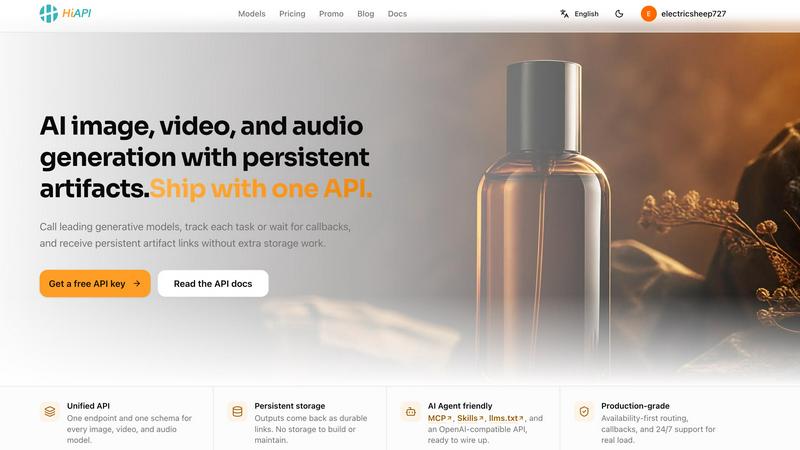
About HiAPI
Every developer building with generative AI has faced the same tangled mess: juggling multiple API keys, deciphering incompatible request formats, wrestling with billing from a dozen different providers, and figuring out where to store the mountains of media those models produce. It is a friction-filled workflow that turns a creative sprint into a bureaucratic crawl. HiAPI is the answer to that frustration. It is a developer-first AI API platform that unifies image, video, and audio generation behind a single, elegant interface. Instead of managing a portfolio of separate accounts, you get one API key, one consistent request schema, and one unified billing system that tracks everything with pay-as-you-go simplicity.
But HiAPI is more than just a pass-through. It was built from the ground up with a deep understanding of how modern AI applications actually work. The platform introduces a task-based architecture that treats every generation as a durable, trackable job. You submit a task, receive an instant ID, and can either poll for status or set up a callback to be notified when the work is done. The output does not vanish into a temporary URL. It comes back as a persistent artifact link, stored reliably so you never have to build your own storage layer or worry about files expiring at the worst possible moment.
HiAPI is designed for two distinct audiences. For traditional developers, it offers comprehensive API documentation, SDKs for popular languages like JavaScript and Python, and a familiar OpenAI-compatible request format that makes migration trivial. For the emerging world of AI agents, HiAPI is a first-class citizen. It supports Model Context Protocol (MCP), reusable agent Skills, and an llms.txt prompt that lets any agent instantly understand how to discover, call, and compose the platform. Whether you are building a production application or wiring up an autonomous agent, HiAPI gives you the tools to ship fast and scale without the overhead.
Features of HiAPI
Unified Task API
At the heart of HiAPI lies a single, consistent task-based API that works identically across every model. You submit a job by passing the model name, your input parameters, and optional settings for routing, storage, and callbacks. The platform returns a unique task ID and handles the rest. This means you never have to learn a new API for each model. The same curl command that generates an image with GPT Image 2 can be adapted to create a video with Seedance 2.0 or compose a song with MiniMax Music 2.6. The lifecycle is always the same: submit, track, and retrieve.
Persistent Artifact Storage
One of the most overlooked headaches in generative AI is output storage. Models return URLs that expire, forcing developers to build download pipelines, set up cloud storage buckets, and manage file lifecycles. HiAPI eliminates this entirely. When you set the storage parameter to persistent, every output is stored as a durable link that remains accessible indefinitely. This is not just a convenience. It is a production-grade feature that saves you from writing and maintaining thousands of lines of storage infrastructure code.
AI Agent Ready Architecture
HiAPI was built with the future of development in mind, a future where AI agents are first-class users of your API. The platform provides three distinct integration paths for agents. MCP tools give agents direct access to HiAPI workflows. Skills are reusable, natural language instructions that teach an agent how to perform common tasks like generating an image or editing a video. The llms.txt prompt acts as a discovery document, allowing any agent to instantly understand the full capabilities of the platform and choose the best integration method.
Transparent and Predictable Pricing
Every model on HiAPI lists its price upfront, with no hidden fees or surprise charges. This transparency lets you accurately estimate costs before you write a single line of integration code. The pay-as-you-go model means you only pay for what you use, and the unified billing system consolidates all charges into a single invoice. For teams building production applications, this predictability is critical for budgeting and scaling.
Use Cases of HiAPI
Rapid Prototyping of Generative Features
Product teams can use HiAPI to quickly prototype and validate generative AI features without committing to a specific model provider. The unified API allows you to swap between models by changing a single string in your request. You can test GPT Image 2 for one feature, switch to FLUX 1.1 Pro for another, and evaluate Seedream 5.0 Pro for a third, all within the same codebase. This flexibility dramatically accelerates the experimentation phase of development.
Building AI-Powered Content Platforms
Startups and media companies building platforms for content creation can leverage HiAPI as their generative backbone. The persistent storage feature is particularly valuable here, as it allows users to generate, save, and retrieve media assets without the platform needing to manage complex storage infrastructure. The callback system enables asynchronous workflows where users can submit generation tasks and be notified when their content is ready, creating a smooth and responsive user experience.
Integrating Generative AI into Agentic Workflows
Developers building AI agents with tools like Claude, Cursor, or Codex can wire HiAPI directly into their agent's capabilities. An agent can be given a Skill that instructs it on how to generate an image to illustrate a concept, compose background music for a video, or create a visual mockup. The agent discovers the API through the llms.txt prompt, chooses the appropriate integration method, and executes the task autonomously. This opens up entirely new categories of agent-driven content creation.
Automating Media Production Pipelines
Marketing teams and creative agencies can build automated media production pipelines around HiAPI. A script can be written to submit a batch of text-to-image tasks for a social media campaign, check their status via the task API, and collect the persistent artifact links for distribution. When a new video model like Seedance 2.0 is released, the pipeline can be updated by simply changing the model name in the configuration. This reduces the operational overhead of managing multiple creative tools and providers.
Frequently Asked Questions
How does HiAPI handle model compatibility and API changes?
HiAPI abstracts away the differences between model providers by normalizing their APIs into a single, consistent schema. When a model provider updates their API, HiAPI handles the migration behind the scenes, so your integration code remains unchanged. You simply pass the model name and your input parameters, and the platform translates the request into the appropriate format for the underlying provider. This insulation protects your application from the churn of individual model APIs.
What is the difference between the standard route and the beta or ext routes?
The route parameter allows you to specify which version of a model you want to call. The default route uses the stable, production-ready version of the model. The ext route may provide access to extended capabilities or higher rate limits. The beta route gives you early access to experimental features that are not yet fully stable. This flexibility lets you choose between reliability and cutting-edge features based on your use case.
How does the task lifecycle work with callbacks and idempotency?
When you submit a task, HiAPI generates a unique task ID and returns it immediately. You can then poll the task status endpoint to check for completion. Alternatively, you can provide a callback URL, and HiAPI will send a POST request to that URL when the task reaches its final state. The idempotency key ensures that retrying the same request does not create duplicate tasks, which is critical for handling network failures and retries in production systems.
What models are currently available on HiAPI and how are new models added?
HiAPI offers a curated selection of leading models for image, video, and audio generation. Current image models include GPT Image 2, Nano Banana 2, FLUX 1.1 Pro, and Seedream 5.0 Pro. Video models include Seedance 2.0. Audio models include MiniMax Music 2.6. New models are added regularly based on community demand and model quality. You can explore all available models on the HiAPI models page, where each model has its own detailed page with API usage, parameters, and pricing information.
Pricing of HiAPI
HiAPI operates on a transparent, pay-as-you-go pricing model. Every model on the platform lists its price per unit of output upfront, allowing you to estimate costs before you integrate. New users can sign up and receive up to 1 dollar in free credits to explore the platform. There are no monthly subscription fees, no minimum commitments, and no hidden charges. You are billed based on your actual usage, with all charges consolidated into a single invoice through the unified billing system. This model is designed to scale with your needs, from a single prototype to a high-volume production application.
Similar to HiAPI

AI Album Cover Maker
Create release-ready album covers from a prompt or photo. Generate, refine, and export art for singles, EPs, mixtapes, and playlists.
Sprite Sheet Maker
A free browser-based toolkit for creating, cutting, converting, and previewing sprite sheet animations.

Flux Lora
Explore Flux LoRA online workflows and the roadmap for models, generation, and training.

Seedream 5.0
Generate and edit production-ready images with Seedream 5.0 Pro and Lite for ecommerce, marketing, social media, and branded content.

Wan Video
Wan Video is an AI video generator and API for Wan 2.7, turning text or images into videos online.

Try This Skill
One-click AI photo stylization for e-commerce & portraits
Vismuse
Create polished AI images and videos from prompts or references for social posts, ads, flyers, album covers, and campaigns.