
Oneprofile vs Playwriter
Side-by-side comparison to help you choose the right product.

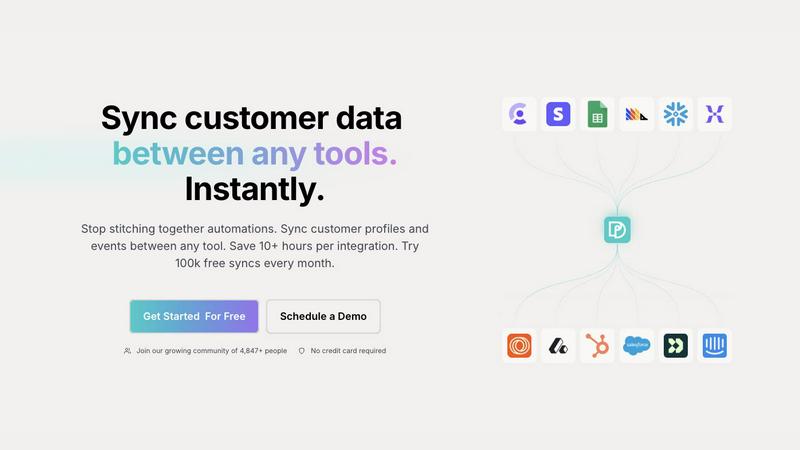
Oneprofile seamlessly syncs customer profiles and events across tools, ensuring consistent data and saving you valuable.
Last updated: February 27, 2026

Playwriter
Give your AI agents the keys to your real browser, complete with your logins and extensions, for seamless automation.
Last updated: March 18, 2026
Visual Comparison
Oneprofile
Playwriter

Feature Comparison
Oneprofile
Keep Customer Data Aligned Across Your Stack
Oneprofile ensures that customer profiles and events remain consistent across each system, even as data evolves over time. This feature eliminates the risk of data duplication and drift, providing users with a reliable source of truth.
Unify Customer Profiles Across Tools
With Oneprofile, organizations can consolidate customer profiles and events from diverse SaaS tools into a cohesive model. This means that CRMs, marketing platforms, and analytics tools can all reference the same customer data, enhancing collaboration and effectiveness.
Control How Data Moves Between Systems
Oneprofile empowers users to define the flow of customer data between various tools. Whether needing one-way or two-way data syncs, users can map fields, control sync directions, and set specific triggers for updates, adapting to their unique business processes.
Activate Customer Data Everywhere
This feature allows businesses to leverage unified customer profiles for segmentation and personalized marketing efforts. By syncing enriched data in real-time, teams can ensure that every department has the full context of customer interactions, improving decision-making and customer engagement.
Playwriter
Your Actual Browser Session
Playwriter's core magic is its ability to let AI agents operate within your existing, logged-in Chrome session. Instead of spawning a fresh, "incognito-like" instance that has no memory and triggers security flags, the agent works directly in a tab you control. All your cookies, active logins to sites like Gmail or GitHub, and essential browser extensions (like password managers or ad blockers) are present and functional. This eliminates the biggest hurdles in web automation: authentication walls and instant bot detection, creating a seamless and realistic browsing environment.
Full Playwright API via a Single Tool
Unlike other systems that limit agents to a pre-defined, narrow set of actions (like "click button" or "extract text"), Playwriter exposes the entire powerful Playwright automation library through one flexible execute command. This means your AI can write and run any Playwright code—setting breakpoints, intercepting network requests, profiling performance, or taking efficient accessibility snapshots. This "one tool to rule them all" approach keeps the AI's context window clean and unleashes sophisticated automation far beyond basic point-and-click scripts.
Live Collaboration and Debugging
This feature transforms automation from a black-box process into a transparent, collaborative session. You watch every action happen in real-time in your browser. If the agent encounters a captcha, you solve it. If it gets stuck on a dynamic element, you can pause, manually fix the page state, and let it continue. The integrated debugger and live code editor allow for on-the-fly adjustments. You're not just launching a script and hoping for the best; you're pair-programming with your AI, guiding it through the unpredictable web.
Lightweight Accessibility Snapshots
Traditional methods for letting AI "see" a page involve full screenshots, which are large (100KB+) and context-heavy. Playwriter captures intelligent, structured accessibility snapshots that are only 5-20KB. These snapshots provide the AI with a semantic understanding of the page—the roles, names, and states of every interactive element—without the visual bloat. This allows the agent to make precise decisions (e.g., click('aria-ref=e5')) efficiently, drastically reducing the cognitive and token load compared to analyzing pixel-based images.
Use Cases
Oneprofile
Marketing Automation
Marketing teams can use Oneprofile to sync customer data across various marketing platforms, ensuring that campaigns are informed by the latest customer interactions. This leads to more targeted and effective marketing strategies.
Customer Support Enhancement
Support teams can access unified customer profiles, enabling them to provide faster and more informed assistance. With accurate data at their fingertips, agents can resolve issues promptly, improving customer satisfaction.
Sales Alignment
Sales teams can rely on Oneprofile to maintain up-to-date customer information across their CRM and other sales tools. This ensures that sales representatives have a complete view of customer interactions, leading to more effective sales conversations.
Product Development Insights
By syncing customer feedback and usage data across tools, product teams can gain valuable insights into customer needs and preferences. This data-driven approach helps in developing features that truly resonate with users, enhancing product-market fit.
Playwriter
Automated Research and Data Aggregation
Envision tasking your AI with compiling a report on market trends. With Playwriter, it can log into your subscribed news sites, navigate past paywalls using your credentials, search across multiple platforms, and systematically extract relevant data into a structured format—all while you monitor its progress and assist only when a login verification pops up. It turns hours of manual browsing into a supervised, automated data-gathering mission.
Testing and Debugging Web Applications
As a developer, you can instruct your AI assistant to test a new user flow on your web app. Using Playwriter, the agent can interact with the application as a real user would, using your actual test account. It can execute complex sequences, intercept network calls to verify API payloads, and use the debugger to pause execution and inspect element states, providing deep, actionable insights far beyond simple "does it load" checks.
Repetitive Administrative Tasks
Free yourself from the monotony of daily digital chores. Whether it's downloading bank statements, filing routine forms on a government portal, or managing content across multiple CMS platforms, Playwriter enables your AI to perform these tasks reliably. Since it uses your authenticated sessions, it can navigate the often-complex, login-heavy interfaces of these services that would typically block a headless bot.
AI-Powered Web Interaction and Automation
This is for creating truly intelligent, adaptive web agents. Imagine an AI that can monitor a product page for stock changes, automatically apply discount codes from your email extension, and complete the checkout process. Or an agent that participates in a complex web-based workflow, making decisions based on live data it reads from the page. Playwriter provides the realistic, tool-rich environment needed for such advanced autonomous operations.
Overview
About Oneprofile
Oneprofile is a groundbreaking solution designed to sync customer profiles and events seamlessly across all the tools utilized by a company. In today's fast-paced digital landscape, businesses often grapple with fragmented customer data, leading to inconsistencies and inefficiencies. Oneprofile addresses this issue by maintaining a single, accurate view of each customer, regardless of where the information resides. This innovative tool is tailored for businesses of all sizes that rely on multiple software solutions, such as CRMs, analytics platforms, marketing tools, and customer support systems. With Oneprofile, businesses can wave goodbye to manual data entry and broken integrations. Every time customer data changes, it is reflected instantly across all platforms, ensuring that teams are always working with the most accurate information. The primary value proposition lies in its ability to save time, reduce errors, and enhance collaboration, allowing businesses to focus on what truly matters: building strong relationships with their customers.
About Playwriter
Imagine your AI assistant, eager to help you research or automate a task online, but it's like a stranger in a foreign land. It opens a brand-new, empty browser with no memory of your logins, no trusted extensions, and is immediately flagged as a suspicious bot. The journey ends before it even begins. Playwriter changes that story. It's the bridge between your AI's potential and the real, lived-in digital world of your actual browser. With a simple Chrome extension and a powerful API, Playwriter grants AI agents—like those in Cursor, Claude Desktop, or VS Code—direct access to your browsing session. This means they operate with all your cookies, saved passwords, installed extensions, and established user history, bypassing bot detection and memory overhead. It's not just automation; it's a collaborative partnership where the AI handles the tedious navigation and data gathering, and you step in as the human guide for captchas and complex decisions, all while watching the process unfold live in your own browser tab. Open-source and locally run, Playwriter puts you in the director's chair, transforming your AI from a isolated script-kiddie into a powerful, integrated co-pilot for the web.
Frequently Asked Questions
Oneprofile FAQ
How does Oneprofile ensure data consistency across different tools?
Oneprofile employs sophisticated identity resolution techniques to match customer profiles across various systems, ensuring that every tool references the same version of customer data, minimizing discrepancies.
Is Oneprofile easy to integrate with existing software?
Absolutely! Oneprofile is designed for modern teams, allowing for quick setup without the need for extensive engineering resources. Integrations can be completed in minutes, saving significant time compared to traditional methods.
What is the maximum number of syncs allowed per month?
Oneprofile offers a generous plan allowing for 100,000 free syncs every month, making it an attractive option for businesses looking to streamline their data management without incurring high costs initially.
Can I customize the sync schedule for my data?
Yes, Oneprofile provides users with the flexibility to set custom sync schedules. Whether you prefer recurring intervals or specific cron jobs, you can tailor the sync process to align with your operational needs.
Playwriter FAQ
How does Playwriter handle security and privacy?
Playwriter is designed with a strong privacy-first approach. All communication happens via a WebSocket relay that runs exclusively on your local machine (localhost:19988). No browsing data, cookies, or commands are sent to any remote server. The project is also open-source (MIT licensed), meaning its code can be audited by anyone. You remain in full control, as the extension must be manually activated per tab.
Can I use Playwriter with any AI or just specific ones?
Playwriter is built on the Model Context Protocol (MCP), an open standard. This means it works seamlessly with any MCP-compatible client. This includes popular AI-powered editors like Cursor and Windsurf, desktop agents like Claude Desktop, and code editors like VS Code with the right extensions. Its flexibility ensures you aren't locked into a single AI ecosystem.
What happens if the AI gets stuck or makes a mistake?
This is where the collaborative nature shines. You are watching the browser tab in real-time. If the agent gets stuck in a loop, clicks the wrong thing, or encounters an unexpected dialog, you can immediately intervene. You can disable the extension for that tab, manually correct the situation (e.g., navigate back, close a pop-up), then re-enable control. The agent can then continue from the new page state.
Does running Playwriter slow down my browser?
Playwriter is designed to be lightweight. It does not spawn a separate Chrome process, so it avoids the "double memory" penalty of traditional headless automation. The extension and local relay add minimal overhead. The primary performance impact would be from the Playwright commands themselves (e.g., rapidly loading many pages), which is similar to what would happen if you were manually performing those actions.
Alternatives
Oneprofile Alternatives
Oneprofile is a powerful tool designed to streamline the synchronization of customer profiles and events across various platforms, placing it squarely in the Analytics & Data category. By ensuring that customer data remains consistent and up-to-date across CRMs, analytics, support, and marketing systems, Oneprofile eliminates the hassle of dealing with multiple versions of the same customer profile. However, users often seek alternatives for a variety of reasons, including budget constraints, specific feature requirements, or compatibility with existing platforms. When exploring alternatives, it’s essential to consider factors such as the ease of integration, the breadth of features offered, and the overall user experience to ensure that the chosen solution aligns with your business needs and enhances your customer data management.
Playwriter Alternatives
Playwriter is an automation tool that gives AI agents the power to control your real Chrome browser. It solves a critical pain point: agents typically operate in isolated, sterile browser sessions with no logins, extensions, or history, making real-world web tasks impossible. Playwriter bridges this gap by providing access to your actual browsing environment. Users explore alternatives for various reasons. Some need a solution tailored to a different browser or platform, while others might prioritize specific features like a different licensing model or a more graphical interface over a command-line tool. Budget considerations and integration with existing tech stacks also commonly drive the search for other options. When evaluating alternatives, focus on the core problem you need to solve. Consider whether the tool provides authentic browser session access, its compatibility with your preferred AI agents and workflows, and the depth of its automation capabilities. Security, transparency, and the ability to debug and control the automation process are also crucial factors for a reliable and trustworthy solution.