
OGimagen vs OpenMark AI
Side-by-side comparison to help you choose the right product.

Transform your content into stunning, platform-perfect social images with AI, then copy and paste the ready-made meta tags to ship.
Last updated: March 11, 2026

Stop guessing which AI model fits your task and let OpenMark benchmark over 100 models for you in minutes.
Last updated: March 26, 2026
Visual Comparison
OGimagen
OpenMark AI
Feature Comparison
OGimagen
AI-Powered, Multi-Format Generation
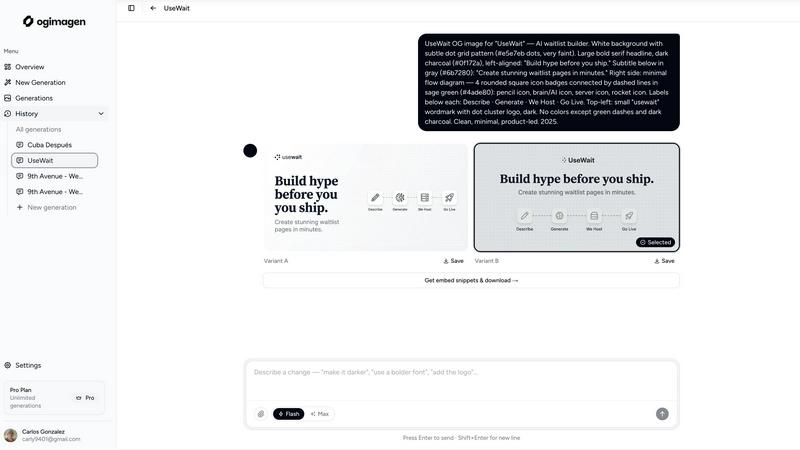
Describe your vision with a title and description, and watch as OGimagen's artificial intelligence brings it to life. It doesn't just create one image; it generates two unique variants (A & B) and automatically tailors them into three perfectly optimized formats for the major platforms: a 1200x630px OG Image for Facebook and Discord, a 1200x600px Twitter Card, and a 1200x627px LinkedIn Card. This ensures your content looks pixel-perfect and professional wherever it's shared, saving you from manual resizing and guesswork.
Framework-Specific Meta Tag Snippets
The journey from a beautiful image to it actually appearing on social media involves code. OGimagen bridges this gap effortlessly. Immediately after generation, you are provided with ready-to-paste meta tag snippets tailored to your tech stack. While free users get the essential HTML, Pro users unlock specialized snippets for modern frameworks like Next.js (App and Pages Router), Astro, SvelteKit, and Remix, making integration a simple copy-paste operation.
MCP Editor Integration
For developers, the true magic happens when tools fit directly into their workflow. OGimagen's Pro plan offers powerful MCP (Model Context Protocol) integration, allowing you to generate and manage OG images without ever leaving your code editor. Connect it to Claude Code, Cursor, Windsurf, or any MCP-compatible tool to create images, list past generations, and grab embed snippets directly from your coding environment, streamlining your development journey.
Global CDN Hosting & Delivery
Once your image is created, the journey of delivery begins. OGimagen hosts every generated image on a fast, global Cloudflare CDN. This means your social cards load instantly for users anywhere in the world, ensuring reliable preview display. Pro plans offer permanent hosting, while one-time packs include generous hosting periods (45 or 90 days), guaranteeing your links look great long after you hit publish.
OpenMark AI
Plain Language Task Description
Forget complex configuration files or scripting. OpenMark AI lets you start your benchmarking journey by simply describing the task you want to test in everyday language. Whether it's "extract dates and product names from customer emails" or "generate three creative taglines for a new coffee brand," you define the challenge naturally. The platform then helps you structure this into a validated benchmark, removing the technical barrier to rigorous testing and letting you focus on what matters: the task itself.
Multi-Model Comparison in One Session
The core of OpenMark's power is its ability to run your exact same prompt against dozens of leading models from providers like OpenAI, Anthropic, and Google simultaneously. You don't have to run separate tests, copy outputs between tabs, or manually calculate costs. In one unified session, you get side-by-side results, allowing for a direct, apples-to-apples comparison that reveals clear winners and surprising contenders for your specific use case.
Holistic Performance Metrics
OpenMark moves beyond simple accuracy. It provides a multi-dimensional report card for each model, including scored quality for your task, the actual cost per API request, response latency, and—importantly—stability metrics from repeat runs. This last feature shows you the variance in outputs, helping you identify models that are consistently good versus those that just got lucky once, which is critical for shipping reliable features.
Hosted Benchmarking with Credits
To streamline your exploration, OpenMark operates on a credit system, eliminating the need for you to obtain, configure, and manage separate API keys for every model provider you want to test. This hosted approach means you can start benchmarking immediately, with all the complexity handled in the background. It turns a multi-day setup process into a few clicks, making sophisticated model evaluation accessible to every developer and team.
Use Cases
OGimagen
Bloggers and Content Creators
For every new article or post, a captivating social preview is essential for driving traffic. A blogger can use OGimagen to quickly generate a unique, on-brand image for each piece of content. By simply inputting the article's headline and a short excerpt, they receive a professional card that teases the content, significantly increasing the likelihood of clicks when shared across Twitter, LinkedIn, and Facebook communities.
SaaS and Product Launch Teams
Launching a new feature or product update? The shared announcement link needs to make an impact. Product teams can use OGimagen to create sleek, branded preview images that highlight the launch. Using MCP integration, a developer can even generate the perfect image and embed code directly from their editor while updating the marketing site, ensuring a cohesive and professional launch narrative across all shared channels.
Digital Marketing Agencies
Agencies managing multiple client accounts need to produce consistent, high-quality social assets at scale. OGimagen allows them to maintain brand integrity for each client by saving brand colors and styles. They can rapidly generate batches of OG images for client blog campaigns, product pages, or landing pages, delivering professional results quickly without needing a dedicated designer for every single asset.
Indie Hackers and Solo Developers
Solo builders wear many hats and efficiency is key. An indie hacker launching a side project can use OGimagen's free tier to instantly create polished social cards for their launch on Product Hunt or Hacker News. They can then easily embed the correct meta tags into their simple HTML site, ensuring their project makes a strong first impression without investing time or money into complex design software.
OpenMark AI
Validating a Model Before Feature Ship
A product team is weeks away from launching a new AI-powered summarization feature. They've shortlisted three models but need concrete data to make the final, responsible choice. Using OpenMark, they benchmark all three on their actual user prompts, comparing not just summary quality but also cost efficiency and consistency. The evidence guides them to the optimal model, de-risking the launch and ensuring a high-quality user experience from day one.
Cost-Efficiency Analysis for Scaling
A startup with a successful AI chatbot needs to optimize its growing inference costs. They suspect a smaller, cheaper model might perform adequately for most user queries. They use OpenMark to run their common question types against both their current premium model and several cost-effective alternatives. The side-by-side comparison of quality scores versus real API costs reveals the perfect balance, potentially saving thousands without degrading service.
Building a Reliable RAG Pipeline
A developer is constructing a Retrieval-Augmented Generation system for a knowledge base. The choice of the final LLM for synthesis is critical. They use OpenMark to test various models with complex, multi-document queries, focusing heavily on the stability metric across repeat runs. This helps them select a model that provides factual, consistent answers every time, which is far more valuable than a model that occasionally produces brilliance but often hallucinates.
Agent Routing and Orchestration Decisions
An engineering team is designing an AI agent that must route subtasks to different specialized models. They need to know which model is best for classification, which excels at data extraction, and which is most cost-effective for simple formatting. OpenMark allows them to create a suite of micro-benchmarks for each task type, building a data-driven routing map that optimizes both performance and budget across their entire agentic workflow.
Overview
About OGimagen
Imagine you've poured your heart into crafting the perfect blog post or launching a new feature for your app. You share the link, full of anticipation, only for it to appear as a bland, text-only box on social media. That crucial first impression is lost. This is the journey OGimagen was born to change. It is your dedicated companion for transforming any web link into a visually compelling story before a single click happens. OGimagen is an AI-powered tool that generates beautiful, platform-optimized Open Graph images in seconds. It's designed for developers, content creators, and marketers who understand that in a crowded digital space, professional link previews are non-negotiable for driving engagement. The tool removes the friction of graphic design, allowing you to input a title, description, and brand colors to receive production-ready social cards. But OGimagen's journey with you doesn't end at creation. It ensures a smooth voyage to deployment by providing the exact meta tag snippets needed for your framework, from Next.js to plain HTML. With features like permanent CDN hosting and direct MCP integration into your coding editor, OGimagen doesn't just create an image; it architects a seamless workflow from idea to a live, click-worthy preview, helping you consistently improve your click-through rates with minimal effort.
About OpenMark AI
Imagine you're building a new AI feature. You've read the spec sheets, you've seen the leaderboards, but a nagging question remains: which model is truly the best for your specific task? Not for a generic benchmark, but for the exact prompt, the precise nuance, the unique data you need to process. This is the journey OpenMark AI was built for. It's a web application that transforms the complex, technical chore of LLM benchmarking into a straightforward, narrative-driven exploration. You simply describe your task in plain language—be it classification, translation, data extraction, or RAG—and OpenMark runs the same prompts against a vast catalog of over 100 models in a single session. The magic happens when you compare the results. You see not just a single, lucky output, but a comprehensive view of scored quality, real API cost per request, latency, and, crucially, stability across repeat runs. This reveals the variance, showing you which models are consistently reliable. Built for developers and product teams making critical pre-deployment decisions, OpenMark eliminates the hassle of configuring separate API keys for every provider. With a hosted, credit-based system, you can focus on finding the model that delivers the right quality for your budget, ensuring your AI feature is built on a foundation of evidence, not guesswork.
Frequently Asked Questions
OGimagen FAQ
What exactly is an OG image?
An OG (Open Graph) image is the preview picture that appears when you share a website link on social media platforms like Facebook, LinkedIn, or Twitter (X). It acts as a visual cover for your content, much like a book cover. A compelling OG image dramatically increases engagement and click-through rates by giving users a visual summary of what they can expect from your link.
What's the difference between Starter, Growth, and Pro?
The Starter and Growth plans are one-time packs for lighter, project-based needs, offering 10 and 25 generations with temporary CDN hosting (45 and 90 days). The Pro plan is a monthly subscription designed for ongoing use, offering 50 generations per month, permanent CDN hosting, and the powerful MCP integration for generating images directly from your code editor, fitting seamlessly into a developer's daily workflow.
What is MCP integration?
MCP (Model Context Protocol) integration allows OGimagen to connect directly with compatible code editors and AI assistants like Claude Code, Cursor, and Windsurf. This means you can command the tool to generate images, list your past creations, and fetch the correct embed code snippets entirely from within your development environment, removing the need to switch contexts to a web browser.
Which frameworks are supported for meta tag snippets?
OGimagen provides snippets for a wide range of modern web frameworks to ensure easy integration. All users receive a plain HTML snippet. Pro users unlock specialized, ready-to-paste code snippets for Next.js (both App Router and Pages Router), Astro, SvelteKit, and Remix. This ensures your generated images can be implemented correctly with just a few clicks, regardless of your tech stack.
OpenMark AI FAQ
How does OpenMark ensure results are accurate and not cached?
OpenMark AI performs real, live API calls to each model provider during every benchmark run. The costs, latencies, and outputs you see are generated on-demand for your specific task. This guarantees you are comparing genuine, current performance data—the same experience you would have integrating the model directly—and not reviewing static, pre-computed marketing numbers that may not reflect real-world conditions.
What kind of tasks can I benchmark with OpenMark?
The platform is designed for a wide array of common and complex AI tasks. You can benchmark models for classification, translation, data extraction, question answering, research synthesis, image analysis, RAG (Retrieval-Augmented Generation) responses, agent routing logic, creative writing, and much more. If you can describe it in a prompt, you can likely build a benchmark for it.
Do I need my own API keys to use OpenMark?
No, one of the key conveniences of OpenMark is that it is a hosted benchmarking service. You operate using credits purchased or obtained through a plan. The platform manages all the underlying API connections to providers like OpenAI, Anthropic, and Google. This means you can start comparing models immediately without the administrative overhead of securing and configuring multiple keys.
Why is measuring stability or variance important?
A single test run can be misleading, as even the best models can occasionally produce a poor output, and weaker models can sometimes get lucky. By running your task multiple times and measuring variance, OpenMark shows you which models are consistently reliable. For shipping a production feature, consistency is often more critical than peak performance, as it builds user trust and ensures a predictable experience.
Alternatives
OGimagen Alternatives
OGimagen is a specialized AI-powered tool in the Dev Tools category, designed to create stunning Open Graph images that make your shared links stand out on social media. It streamlines the process of generating production-ready social cards, helping developers and content creators boost engagement with minimal effort. Users often explore alternatives for various reasons. Some may need a different pricing model or a free tier to fit their budget. Others might seek specific integrations with their existing tech stack, more granular design control, or a platform that offers a broader suite of marketing assets beyond just Open Graph images. When evaluating other options, consider your core needs. Look for a tool that balances ease of use with the flexibility you require. Key factors include the quality and customization of the AI-generated images, compatibility with your website framework, the efficiency of your workflow, and of course, the overall value for your investment.
OpenMark AI Alternatives
Choosing the right LLM for your project is a critical, often frustrating, step. OpenMark AI is a developer tool designed to cut through that uncertainty by letting you benchmark over 100 models on your specific task, comparing real-world cost, speed, quality, and output stability in a single browser session. Developers and teams often explore alternatives for various reasons. Perhaps they need a solution that integrates directly into their CI/CD pipeline, requires a self-hosted option for data governance, or operates on a different pricing model. The needs of a solo builder differ from those of an enterprise team. When evaluating other tools in this space, focus on what matters for your workflow. Key considerations include whether the tool tests with live API calls or cached data, how it measures and scores output quality for your use case, its model catalog coverage, and how it handles the practicalities of API keys and cost transparency across providers.