
Local Tools vs OpenMark AI
Side-by-side comparison to help you choose the right product.

Local Tools
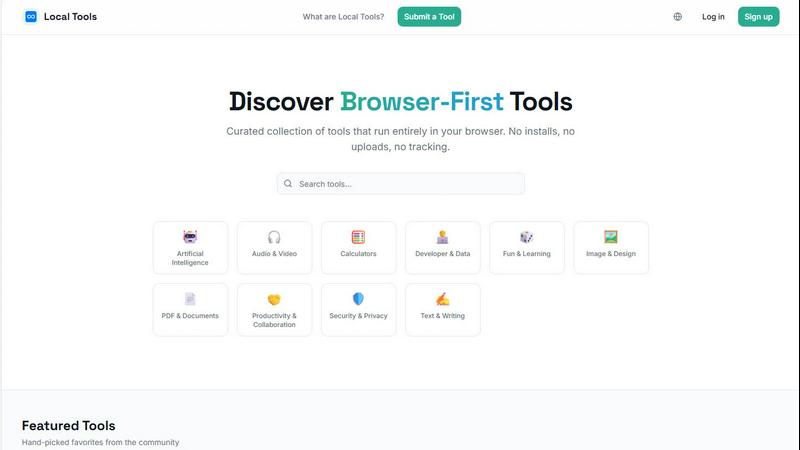
Discover and use thousands of private, browser-based tools that run directly on your device with no installs or tracking.
Last updated: April 4, 2026

Stop guessing which AI model fits your task and let OpenMark benchmark over 100 models for you in minutes.
Last updated: March 26, 2026
Visual Comparison
Local Tools
OpenMark AI
Feature Comparison
Local Tools
Curated, Browser-First Directory
Local Tools is not a random aggregation of links; it is a thoughtfully curated collection of over a thousand utilities that are verified to run client-side in your browser. Each tool is categorized—like Image & Design, Developer & Data, or Security & Privacy—creating a structured, navigable library. This curation ensures quality and functionality, saving you from the repetitive and often low-quality alternatives scattered across the web. It’s your map to the best on-device tools available.
Complete Privacy & On-Device Processing
The core promise of Local Tools is uncompromising privacy. Every tool listed operates locally on your machine. Your files, data, and activities never get uploaded to external servers for processing. This means no risk of third-party data mining, no tracking of your usage patterns, and no reliance on an internet connection for the core functionality. It’s a secure, self-reliant way to work, giving you full control and peace of mind.
Streamlined Discovery & Comparison
Finding the right tool for a specific job can be a journey of endless tabs and bookmarks. Local Tools ends that hunt. By bringing thousands of utilities under one roof and organizing them by category and community ratings, it allows for effortless exploration and side-by-side comparison. You can quickly see user ratings, descriptions, and functionalities to choose the most suitable option without ever leaving the platform.
Community-Driven Curation & Submission
The directory is alive and grows through its community. Users can submit new browser-based tools they discover, contributing to the ever-expanding resource. This community-driven model, combined with featured "hand-picked favorites," ensures the collection stays current, diverse, and rich with high-quality, practical utilities that real people find useful in their daily digital journeys.
OpenMark AI
Plain Language Task Description
Forget complex configuration files or scripting. OpenMark AI lets you start your benchmarking journey by simply describing the task you want to test in everyday language. Whether it's "extract dates and product names from customer emails" or "generate three creative taglines for a new coffee brand," you define the challenge naturally. The platform then helps you structure this into a validated benchmark, removing the technical barrier to rigorous testing and letting you focus on what matters: the task itself.
Multi-Model Comparison in One Session
The core of OpenMark's power is its ability to run your exact same prompt against dozens of leading models from providers like OpenAI, Anthropic, and Google simultaneously. You don't have to run separate tests, copy outputs between tabs, or manually calculate costs. In one unified session, you get side-by-side results, allowing for a direct, apples-to-apples comparison that reveals clear winners and surprising contenders for your specific use case.
Holistic Performance Metrics
OpenMark moves beyond simple accuracy. It provides a multi-dimensional report card for each model, including scored quality for your task, the actual cost per API request, response latency, and—importantly—stability metrics from repeat runs. This last feature shows you the variance in outputs, helping you identify models that are consistently good versus those that just got lucky once, which is critical for shipping reliable features.
Hosted Benchmarking with Credits
To streamline your exploration, OpenMark operates on a credit system, eliminating the need for you to obtain, configure, and manage separate API keys for every model provider you want to test. This hosted approach means you can start benchmarking immediately, with all the complexity handled in the background. It turns a multi-day setup process into a few clicks, making sophisticated model evaluation accessible to every developer and team.
Use Cases
Local Tools
The Designer's Instant Editing Studio
A graphic designer receives a last-minute request to convert a batch of SVG files to WebP and quickly remove a background from a product shot. Instead of launching heavy software or trusting sensitive client assets to an unknown website, they visit Local Tools. Within moments, they find dedicated, browser-based converters and an editor like Photopea—a Photoshop alternative—all running locally. The work is done swiftly, privately, and without any installs, keeping their creative flow uninterrupted.
The Developer's Quick Utility Belt
A developer debugging an API response needs to visualize a complex JSON object. They could write a script or search for a standalone app. Instead, they head to Local Tools, find JSON Crack in the Developer & Data section, and paste their code. The data instantly transforms into an interactive graph right in their browser, aiding debugging. Later, they might use a text diff checker or a code formatter from the same hub, all without context-switching to different sites.
The Student's Secure Research Companion
A student working on a thesis needs to merge several PDF articles, count words across multiple documents, and protect their final submission with a password. Concerned about privacy and unwilling to upload academic work to random online services, they use Local Tools. They find all the necessary PDF utilities that process files directly on their laptop, ensuring their research remains confidential while completing essential formatting tasks efficiently.
The Everyday User's Privacy-Conscious Toolkit
Anyone planning their finances can use a salary calculator; someone formatting a resume can use a bullet point generator; a hobbyist can optimize images for a blog with Squoosh. For these everyday tasks, Local Tools provides a trustworthy, ad-free alternative to sketchy websites. Users accomplish their goals without the overhead of software installation or the unease of data tracking, making digital life simpler and more secure.
OpenMark AI
Validating a Model Before Feature Ship
A product team is weeks away from launching a new AI-powered summarization feature. They've shortlisted three models but need concrete data to make the final, responsible choice. Using OpenMark, they benchmark all three on their actual user prompts, comparing not just summary quality but also cost efficiency and consistency. The evidence guides them to the optimal model, de-risking the launch and ensuring a high-quality user experience from day one.
Cost-Efficiency Analysis for Scaling
A startup with a successful AI chatbot needs to optimize its growing inference costs. They suspect a smaller, cheaper model might perform adequately for most user queries. They use OpenMark to run their common question types against both their current premium model and several cost-effective alternatives. The side-by-side comparison of quality scores versus real API costs reveals the perfect balance, potentially saving thousands without degrading service.
Building a Reliable RAG Pipeline
A developer is constructing a Retrieval-Augmented Generation system for a knowledge base. The choice of the final LLM for synthesis is critical. They use OpenMark to test various models with complex, multi-document queries, focusing heavily on the stability metric across repeat runs. This helps them select a model that provides factual, consistent answers every time, which is far more valuable than a model that occasionally produces brilliance but often hallucinates.
Agent Routing and Orchestration Decisions
An engineering team is designing an AI agent that must route subtasks to different specialized models. They need to know which model is best for classification, which excels at data extraction, and which is most cost-effective for simple formatting. OpenMark allows them to create a suite of micro-benchmarks for each task type, building a data-driven routing map that optimizes both performance and budget across their entire agentic workflow.
Overview
About Local Tools
Imagine a digital workshop where every tool you need is laid out on a clean, organized bench, ready to use instantly without any setup. This is the journey Local Tools invites you on. It's more than just a website; it's a curated hub, a sanctuary for anyone who values speed, privacy, and simplicity in their digital tasks. In a world where our data is constantly in transit, Local Tools offers a different path: a collection of thousands of utilities that run entirely within your browser. No software to install, no files to upload to distant servers, and no hidden trackers monitoring your clicks. Everything happens right on your device, turning your browser into a powerful, self-contained workstation.
Built for the curious and the practical—developers tweaking code, designers perfecting an image, students analyzing data, or professionals managing documents—Local Tools simplifies discovery. Instead of wandering the fragmented web, searching for a trustworthy image converter or a secure PDF editor, you arrive at a single, organized directory. It’s structured by function, from AI and audio editing to text writing and security, making it easy to explore, compare, and find the perfect tool for the moment. It’s about reclaiming your workflow, ensuring your creations and data never leave your side, and uncovering hidden gems you might never have found on your own. Your journey to efficient, private computing starts here.
About OpenMark AI
Imagine you're building a new AI feature. You've read the spec sheets, you've seen the leaderboards, but a nagging question remains: which model is truly the best for your specific task? Not for a generic benchmark, but for the exact prompt, the precise nuance, the unique data you need to process. This is the journey OpenMark AI was built for. It's a web application that transforms the complex, technical chore of LLM benchmarking into a straightforward, narrative-driven exploration. You simply describe your task in plain language—be it classification, translation, data extraction, or RAG—and OpenMark runs the same prompts against a vast catalog of over 100 models in a single session. The magic happens when you compare the results. You see not just a single, lucky output, but a comprehensive view of scored quality, real API cost per request, latency, and, crucially, stability across repeat runs. This reveals the variance, showing you which models are consistently reliable. Built for developers and product teams making critical pre-deployment decisions, OpenMark eliminates the hassle of configuring separate API keys for every provider. With a hosted, credit-based system, you can focus on finding the model that delivers the right quality for your budget, ensuring your AI feature is built on a foundation of evidence, not guesswork.
Frequently Asked Questions
Local Tools FAQ
How does Local Tools ensure my privacy?
Local Tools is a directory, not a processor. We list tools that are built to run entirely within your web browser. This means when you use a tool like Photopea or a PDF converter, your files and data are processed directly on your computer's hardware. They are never uploaded to our servers or the tool creator's servers (unless the tool itself states otherwise). We prioritize listing tools that adhere to this client-side principle, giving you a privacy-first experience.
Do I need to create an account to use the tools?
No, you do not need an account to browse the Local Tools directory or to use the vast majority of tools listed. The tools themselves are external websites, and most are designed to be used immediately without sign-ups. An account on Local Tools is only needed if you wish to participate in the community by rating tools or submitting new ones to the directory.
Are the tools on Local Tools completely free to use?
Local Tools features a wide variety of utilities, and the pricing model is set by each tool's developer. Many of the tools listed, such as Squoosh, Photopea, and Excalidraw, are free to use. Some may offer premium features or subscriptions. Each tool's listing will direct you to its official website where you can find specific details about its cost, if any.
How can I suggest a new tool to be added to the directory?
We welcome and rely on community contributions! If you've found a fantastic browser-based tool that runs locally and isn't yet in our directory, you can submit it for review. Simply click the "Submit a Tool" link in the website's navigation. Our team will review the submission to ensure it meets our criteria for quality, functionality, and privacy before adding it to the curated collection.
OpenMark AI FAQ
How does OpenMark ensure results are accurate and not cached?
OpenMark AI performs real, live API calls to each model provider during every benchmark run. The costs, latencies, and outputs you see are generated on-demand for your specific task. This guarantees you are comparing genuine, current performance data—the same experience you would have integrating the model directly—and not reviewing static, pre-computed marketing numbers that may not reflect real-world conditions.
What kind of tasks can I benchmark with OpenMark?
The platform is designed for a wide array of common and complex AI tasks. You can benchmark models for classification, translation, data extraction, question answering, research synthesis, image analysis, RAG (Retrieval-Augmented Generation) responses, agent routing logic, creative writing, and much more. If you can describe it in a prompt, you can likely build a benchmark for it.
Do I need my own API keys to use OpenMark?
No, one of the key conveniences of OpenMark is that it is a hosted benchmarking service. You operate using credits purchased or obtained through a plan. The platform manages all the underlying API connections to providers like OpenAI, Anthropic, and Google. This means you can start comparing models immediately without the administrative overhead of securing and configuring multiple keys.
Why is measuring stability or variance important?
A single test run can be misleading, as even the best models can occasionally produce a poor output, and weaker models can sometimes get lucky. By running your task multiple times and measuring variance, OpenMark shows you which models are consistently reliable. For shipping a production feature, consistency is often more critical than peak performance, as it builds user trust and ensures a predictable experience.
Alternatives
Local Tools Alternatives
Local Tools is a unique browser-first directory for utilities that run entirely on your device. It belongs to the category of on-device tool platforms, offering a curated, private, and instant way to access thousands of useful applications without installation or data uploads. People explore alternatives for various reasons. Some may seek different organizational structures, a broader or more niche set of tool categories, or platforms integrated with specific workflows. Others might prioritize community features, different discovery methods, or simply want to compare what else exists in this innovative space. When evaluating other options, consider your core needs. Look for a platform's commitment to privacy and local execution, the depth and quality of its curated tool collection, and how intuitively it helps you discover the right utility for your task. The best choice aligns with your desire for convenience, security, and a streamlined workflow.
OpenMark AI Alternatives
Choosing the right LLM for your project is a critical, often frustrating, step. OpenMark AI is a developer tool designed to cut through that uncertainty by letting you benchmark over 100 models on your specific task, comparing real-world cost, speed, quality, and output stability in a single browser session. Developers and teams often explore alternatives for various reasons. Perhaps they need a solution that integrates directly into their CI/CD pipeline, requires a self-hosted option for data governance, or operates on a different pricing model. The needs of a solo builder differ from those of an enterprise team. When evaluating other tools in this space, focus on what matters for your workflow. Key considerations include whether the tool tests with live API calls or cached data, how it measures and scores output quality for your use case, its model catalog coverage, and how it handles the practicalities of API keys and cost transparency across providers.