
Agent to Agent Testing Platform vs LLMWise
Side-by-side comparison to help you choose the right product.

Agent to Agent Testing Platform
Revolutionize AI agent performance testing with our platform, ensuring accuracy and compliance across all interaction.
Last updated: February 27, 2026

LLMWise
LLMWise simplifies AI access with one pay-as-you-go API, intelligently routing prompts to the best model for every need.
Last updated: February 27, 2026
Visual Comparison
Agent to Agent Testing Platform
LLMWise
Feature Comparison
Agent to Agent Testing Platform
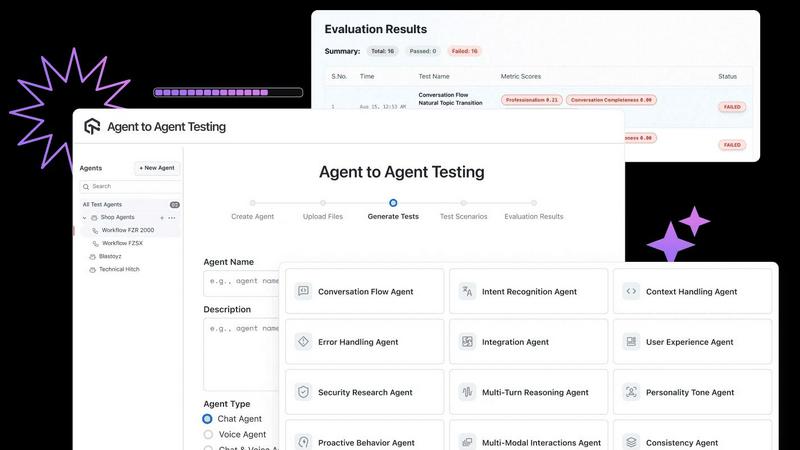
Automated Scenario Generation
This feature allows users to create diverse test cases for AI agents by simulating various types of interactions, including chat and voice scenarios. This automation enhances testing accuracy and ensures comprehensive coverage of potential user interactions.
True Multi-Modal Understanding
The platform supports testing beyond text-based inputs, allowing users to define detailed requirements or upload product requirement documents (PRDs) that include images, audio, and video. This capability ensures that the AI agents are evaluated in contexts that mirror real-world scenarios.
Diverse Persona Testing
Utilizing a range of personas, the platform simulates various end-user behaviors and needs during testing. This feature ensures that AI agents perform effectively across diverse user types, such as digital novices or international callers, enhancing their adaptability and user experience.
Autonomous Testing at Scale
The platform employs synthetic end-users to conduct extensive testing that mirrors production-like interactions. This feature provides a detailed analysis of the AI agent's performance, focusing on key metrics like effectiveness, accuracy, empathy, and professionalism, ensuring a well-rounded evaluation.
LLMWise
Smart Routing
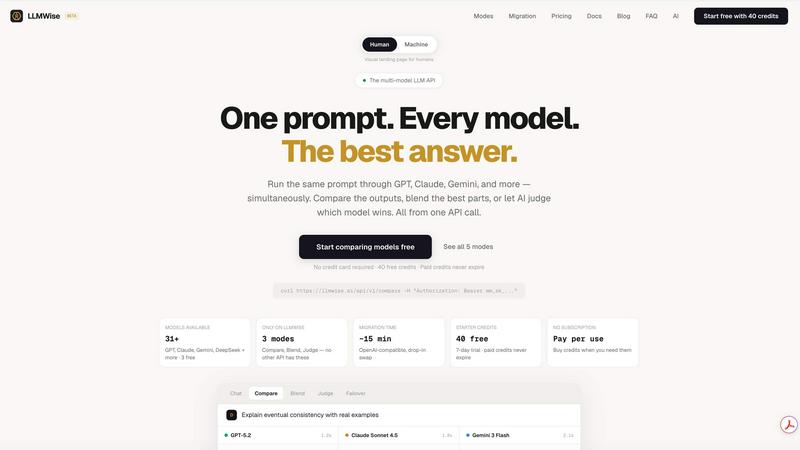
LLMWise's smart routing feature intelligently directs each prompt to the optimal model based on the task at hand. For instance, it sends coding prompts to GPT, creative writing requests to Claude, and translation queries to Gemini. This ensures that users receive the highest quality responses tailored to their specific needs, saving time and increasing efficiency.
Compare & Blend
With the compare and blend feature, users can run prompts across multiple models side-by-side to evaluate their responses directly. The blending capability allows users to synthesize outputs from different models into a single, more robust answer. This not only enhances the quality of the results but also provides insights into the strengths and weaknesses of each model.
Always Resilient
LLMWise boasts an always-resilient architecture that employs circuit-breaker failover mechanisms. This feature reroutes requests to backup models seamlessly when a primary provider experiences downtime. As a result, applications remain operational without interruption, ensuring reliability in critical situations.
Test & Optimize
The tool includes comprehensive benchmarking suites and batch testing functionalities that allow users to optimize their usage based on speed, cost, and reliability. Users can establish automated regression checks to monitor performance continuously, ensuring that their applications benefit from ongoing improvements and adjustments.
Use Cases
Agent to Agent Testing Platform
Quality Assurance for Customer Support Agents
Enterprises can use the platform to rigorously test AI-powered customer support agents, ensuring they handle inquiries effectively while maintaining a high standard of empathy and professionalism. This testing helps organizations enhance their customer service capabilities.
Pre-Deployment Validation for Voice Assistants
Before launching a new voice assistant, companies can utilize the platform to simulate thousands of interactions, validating its responses and ensuring it meets user expectations. This reduces the risk of deployment failures and enhances user satisfaction.
Compliance Testing for AI Behavior
Organizations can leverage the platform to assess AI agents' compliance with internal policies and regulations. By identifying potential bias or toxicity, businesses can take corrective actions before their AI solutions go live.
Performance Optimization for Multimodal Interfaces
The platform allows testing of AI agents that operate across different modalities—text, voice, and video. This ensures that all aspects of the agent's interactions are optimized for performance, leading to a seamless user experience.
LLMWise
Software Development
Developers can utilize LLMWise for software development by routing code-related prompts to the most capable LLMs. By leveraging the smart routing feature, they can quickly identify the best model for specific coding challenges, streamline debugging processes, and enhance overall code quality.
Content Creation
For content creators, LLMWise offers a powerful solution for generating high-quality written material. By comparing outputs from various models, writers can blend the best parts and produce polished articles, stories, or marketing content that resonates with their audience.
Translation Services
Businesses needing translation services can benefit from LLMWise's ability to direct language-related queries to specialized models like Gemini. This ensures accurate and contextually appropriate translations, enhancing communication across different languages and cultures.
Research and Analysis
Researchers and analysts can leverage LLMWise to generate insights and summaries from vast datasets. By routing prompts to the most suitable models for data analysis or summarization, users can obtain coherent and comprehensive overviews, facilitating informed decision-making.
Overview
About Agent to Agent Testing Platform
Agent to Agent Testing Platform is a groundbreaking solution designed to ensure that AI agents, such as chatbots and voice assistants, operate reliably in real-world scenarios. As AI systems evolve into more autonomous entities, traditional quality assurance (QA) methodologies struggle to keep pace with their dynamic behaviors. This platform addresses these challenges by providing a comprehensive framework for evaluating the performance of AI agents across various communication modalities. By leveraging advanced testing capabilities, including multi-agent test generation and autonomous synthetic user simulations, the platform enables businesses to uncover potential failures and assess key performance metrics like bias, toxicity, and hallucinations. It is tailored for enterprises aiming to validate their AI agents thoroughly before deploying them in production environments, ensuring optimal functionality and user satisfaction.
About LLMWise
LLMWise is a groundbreaking software solution that simplifies the use of various large language models (LLMs) for developers and businesses. It unifies access to leading AI models from OpenAI, Anthropic, Google, Meta, xAI, and DeepSeek through a single API, eliminating the need for multiple subscriptions and complex integrations. This innovative tool is designed for developers who want to leverage the best LLMs tailored to specific tasks without the hassle of managing different models and their respective APIs. With intelligent routing, LLMWise ensures that each prompt is sent to the most suitable model, optimizing performance and output quality. Whether you are developing applications for code generation, creative writing, or translation, LLMWise empowers you to achieve better results with less effort. Its value proposition lies in providing flexibility, cost-effectiveness, and a user-friendly experience, enabling users to focus on creativity and productivity rather than managing diverse AI platforms.
Frequently Asked Questions
Agent to Agent Testing Platform FAQ
What types of AI agents can be tested with this platform?
The Agent to Agent Testing Platform is designed to test a variety of AI agents, including chatbots, voice assistants, and phone caller agents, ensuring comprehensive evaluation across different scenarios.
How does the platform ensure comprehensive testing?
The platform utilizes automated scenario generation and diverse persona testing to create a wide array of test cases that simulate real-world interactions, guaranteeing thorough assessment of AI agent performance.
Can I integrate this platform with my existing CI/CD pipeline?
Yes, the Agent to Agent Testing Platform seamlessly integrates with existing CI/CD frameworks, allowing for efficient test orchestration and execution within your current development workflow.
What metrics can I evaluate using this platform?
The platform provides insights into key metrics such as bias, toxicity, hallucinations, effectiveness, accuracy, empathy, and professionalism, enabling organizations to understand and optimize their AI agents' performance comprehensively.
LLMWise FAQ
What types of models can I access with LLMWise?
LLMWise provides access to over 62 models from 20 different providers, including major players like OpenAI, Anthropic, Google, Meta, xAI, and DeepSeek. This variety ensures that users can find the right model for their specific tasks.
How does the failover mechanism work?
The failover mechanism in LLMWise acts as a safety net, automatically rerouting requests to backup models if a primary provider goes down. This guarantees that your application remains functional even during outages, eliminating potential downtime.
Can I use my existing API keys with LLMWise?
Yes, LLMWise allows users to bring their own API keys. This flexibility enables you to leverage existing agreements with providers while benefiting from LLMWise's intelligent routing and orchestration features.
Is there a subscription fee for using LLMWise?
No, LLMWise operates on a pay-as-you-go model, allowing users to pay only for what they use. You can start with 20 free credits, and there are no monthly subscriptions or recurring fees, making it a cost-effective solution for accessing multiple AI models.
Alternatives
Agent to Agent Testing Platform Alternatives
The Agent to Agent Testing Platform is a groundbreaking AI-native quality assurance framework specifically designed to validate the behavior of AI agents across various communication channels, including chat, voice, and multimodal systems. As organizations increasingly adopt autonomous AI systems, many users begin to seek alternatives due to factors like pricing, feature sets, and specific platform requirements that may not be met by a single solution. When considering an alternative, it is crucial to evaluate the comprehensiveness of the testing capabilities, the variety of scenarios it can simulate, and whether it aligns with your organization's unique operational needs. --- [{"question": "What is Agent to Agent Testing Platform?", "answer": "Agent to Agent Testing Platform is an AI-native quality assurance framework that validates AI agent behavior across chat, voice, phone, and multimodal systems."}, {"question": "Who is Agent to Agent Testing Platform for?", "answer": "This platform is designed for enterprises looking to ensure the reliability and compliance of their AI agents before deploying them in production environments."}, {"question": "Is Agent to Agent Testing Platform free?", "answer": "No, Agent to Agent Testing Platform is a specialized solution typically offered as a subscription or licensing model."}, {"question": "What are the main features of Agent to Agent Testing Platform?", "answer": "Key features include multi-agent test generation, autonomous synthetic user testing, and validation for traceability and policy compliance."}]
LLMWise Alternatives
LLMWise is a powerful API that provides seamless access to a range of large language models (LLMs) such as GPT, Claude, and Gemini, among others. It belongs to the AI Assistants category, streamlining the process of leveraging advanced language processing capabilities for various tasks. Users often seek alternatives to LLMWise for reasons such as pricing structures, feature sets, specific platform requirements, or the desire for more tailored solutions. When choosing an alternative, it's essential to consider factors like ease of integration, the variety of models offered, flexibility in pricing, and the ability to optimize tasks based on performance. Additionally, look for features that enhance user experience, such as auto-routing capabilities or robust testing tools that ensure consistent output quality across different applications.